

Vice President Hsiao Bi-khim Attends the Opening Ceremony of the Marie Curie Science Camp Encourages Youth to Solve Challenges Through Innovation and Science
Vice President Hsiao Bi-khim Attends the Opening Ceremony of the Marie Curie Science Camp Encourages Youth to Solve Challenges Through Innovation and Science
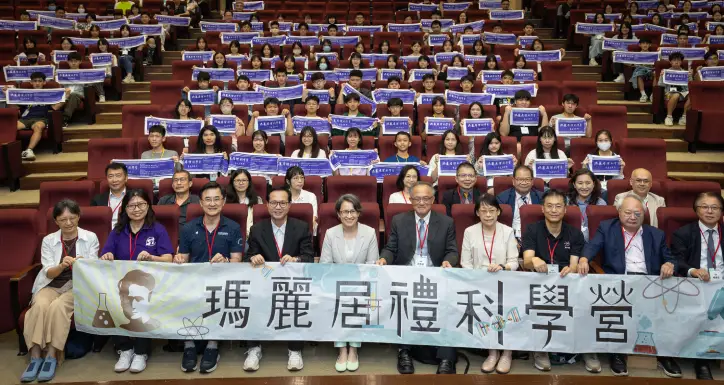
(Source: Office of the President Taiwan)
Vice President Hsiao Bi-khim recently attended the opening ceremony of the 2026 Marie Curie Science Camp, where she emphasized that scientific research is not only a legacy passed across generations and borders, but also a cornerstone of national resilience, technological advancement, and national security. She encouraged participating students to cultivate an innovative mindset and apply scientific knowledge to solve challenges, contributing to Taiwan's security, democracy, and sustainable development.
Vice President Hsiao highlighted scientific research often requires interdisciplinary collaboration to effectively address complex challenges. Citing Marie Curie's scientific achievements as an example, she emphasized the importance of integrating knowledge across disciplines and encouraged the younger generation to develop diverse skills and perspectives to meet the demands of a rapidly changing world.
Addressing the theme of resilience, she explained that resilience is not the absence of risk, but the ability to adapt, respond effectively, and recover quickly in the face of natural disasters, external threats, and unexpected disruptions. She noted that strengthening resilience has become a key priority for Taiwan.
Vice President Hsiao also shared insights from her role as chair of the National Space and Technology Development Committee. She noted that space technologies have become integral to everyday life, supporting applications such as weather forecasting, climate monitoring, disaster response, satellite communications, and submarine cable connectivity. These examples illustrate the close relationship between advanced technologies, public well-being, and national resilience.
She further emphasized the growing connection between scientific innovation and national security. Referring to the U.S. Defense Advanced Research Projects Agency (DARPA), she noted that many of its forward-looking research initiatives have led to the development of transformative technologies such as GPS, the Internet, and LiDAR. These innovations have since been widely adopted across civilian industries, demonstrating the significant value of collaboration between defense research and commercial technological innovation.
As global geopolitics continue to evolve, Vice President Hsiao noted that semiconductors, artificial intelligence, data security, communications, energy, and other emerging technologies have become critical factors shaping national competitiveness. She stressed that nations capable of rapidly integrating new technologies and fostering innovation will be better positioned to strengthen resilience and maintain long-term competitiveness.
To conclude, she encouraged students to embrace scientific thinking by drawing inspiration from the animated series Vicky the Viking. Rather than relying on physical strength, the story's protagonist overcomes challenges through observation, critical thinking, and creative problem-solving, qualities that are equally important for addressing the uncertainties of the future.
As technological innovation continues to accelerate worldwide, the importance of science education, interdisciplinary collaboration, and talent development will only continue to grow. Transforming scientific research into practical industrial applications while cultivating the next generation of innovators will be essential to advancing industrial development, strengthening national resilience, and supporting sustainable growth.
Source: Office of the President Taiwan (English translation and Summary: EnergyOMNI)
