

11th Taiwan-Netherlands Energy and Innovation Cooperation Meeting Focuses on Offshore Multi-Energy Systems and Carbon Capture and Storage
11th Taiwan-Netherlands Energy and Innovation Cooperation Meeting Focuses on Offshore Multi-Energy Systems and Carbon Capture and Storage
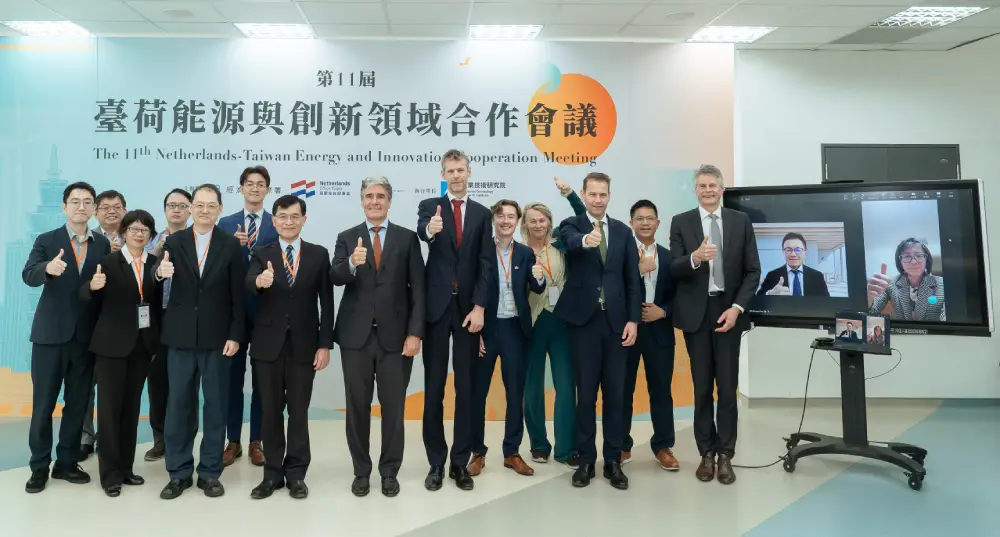
The Energy Administration held the 11th Taiwan-Netherlands Energy and Innovation Cooperation Meeting at the Maritime Technology Innovation Center on October 13.
(Resource: Energy Administration)
The Energy Administration of Ministry of Economic Affairs (MOEA), in collaboration with the Netherlands Office Taipei, held the 11th Taiwan-Netherlands Energy and Innovation Cooperation Meeting (第11屆臺荷能源與創新領域合作會議) on October 13, adopting a hybrid format with both in-person and online participation.
The opening session was co-chaired by Chin-Tsang Ho, Deputy Minister of MOEA, and Bas Pulles, Representative of the Netherlands Office Taipei. Experts and representatives from both sides were invited to share their knowledge and experience in key areas, including multi-energy integration in marine environments, carbon capture and storage (CCS) technologies, and the achievements and future prospects of bilateral working groups on offshore wind power and floating solar photovoltaics.
In his opening remarks, Deputy Minister Ho noted that Taiwan-Netherlands cooperation had entered its 11th year since the signing of a memorandum of understanding (MOU) in 2015. Over the years, the two sides have established a solid foundation for cooperation in renewable energy policy, offshore wind power technology, and marine engineering.
To achieve its 2050 net-zero emissions target and advance the second energy transition, Taiwan is actively promoting a diversified renewable energy portfolio and developing forward-looking technologies to strengthen the competitiveness of its industries in the global green supply chain. Ho also noted that the Netherlands' leading expertise in marine spatial planning and offshore energy aligns closely with Taiwan's goal of optimizing the use of marine space.
Bas Pulles noted that Taiwan and the Netherlands had renewed their MOU on Energy and Innovation Cooperation in May this year, further strengthening their longstanding partnership. In response to the shared challenges of meeting climate targets and achieving net-zero emissions, this year's conference focused on optimizing the spatial allocation of marine areas for multiple energy uses, applying CCS technologies to help industries reduce carbon emissions, and showcasing the achievements of the bilateral working groups on offshore wind power and floating photovoltaics.
In conjunction with the upcoming Energy Taiwan exhibition, the Netherlands also led a delegation of 16 companies and organizations to participate in the event. Through continued in-depth exchanges among government, industry, and academia, the Netherlands aims to identify new opportunities for cooperation and energy transition between Taiwan and the Netherlands, working together to achieve their climate and energy goals.
The conference opened with presentations by Ju-Min Cheng, Section Chief of the Energy Administration, and Henk van Elburg, Senior Advisor at the Netherlands Enterprise Agency (RVO), who shared strategies and outlooks for the development and utilization of multiple energy sources in marine areas in Taiwan and the Netherlands, respectively.
This was followed by presentations from Chung-Hao Lee, Director of the Exploration and Production Business Division at CPC Corporation, Taiwan, and Lucas de Graaf, Public Affairs Advisor at Porthos, who outlined initiatives to advance CCS technologies in Taiwan and the Netherlands.
Building on the outcomes of last year's bilateral cooperation meeting, this year's conference also featured updates and future outlooks from the respective working groups. Brigitte Vlaswinkel, Director at Oceans of Energy and the Dutch representative of the floating solar working group, and Shang-Sheng Jin, Deputy Division Director at the Ship and Ocean Industries R&D Center (SOIC) and Taiwan's representative of the offshore wind working group, shared the groups' achievements and discussed future prospects.
Bart Tonnaer, Director of Climate and Energy Transition at the RVO, concluded that Taiwan and the Netherlands face similar challenges in meeting climate targets and addressing spatial constraints, driving their cooperation beyond policy dialogue toward practical solutions. The conference's focus on the efficient use of marine space for multiple energy applications, in-depth exchanges on CCS, and continued collaboration through the offshore wind power and floating photovoltaics working groups all demonstrated the strong foundation of mutual trust between the two sides.
Following the renewal of the cooperation MOU earlier this year, RVO will continue to strengthen connections among government, industry, academia, and research institutions in both countries, translating the commitments outlined in the MOU into concrete action and advancing the next phase of their shared vision for energy transition.
In his closing remarks, Chih-Wei Wu, Director-General of the Energy Administration under MOEA, emphasized that Taiwan and the Netherlands have long maintained a close partnership in advancing renewable and emerging energy technologies. He noted that the conference had facilitated in-depth technical and policy dialogue on marine energy integration and CCS. The substantial achievements demonstrated by the offshore wind power and floating photovoltaics working groups this year further underscored the solid framework for bilateral exchanges established by the two sides.
Building on this strong foundation, Wu expressed his hope that Taiwan and the Netherlands would continue to deepen technical exchanges, industrial collaboration, and knowledge sharing, creating further opportunities for cooperation in the energy sector and working together toward their shared goal of a sustainable, net-zero future.
Source: Energy Administration, Ministry of Economic Affairs
Compilation & Translation: EnergyOMNI
