

CSBC and DNV Host 2026 Joint Seminar to Accelerate Green Shipping Technology Development
CSBC and DNV Host 2026 Joint Seminar to Accelerate Green Shipping Technology Development
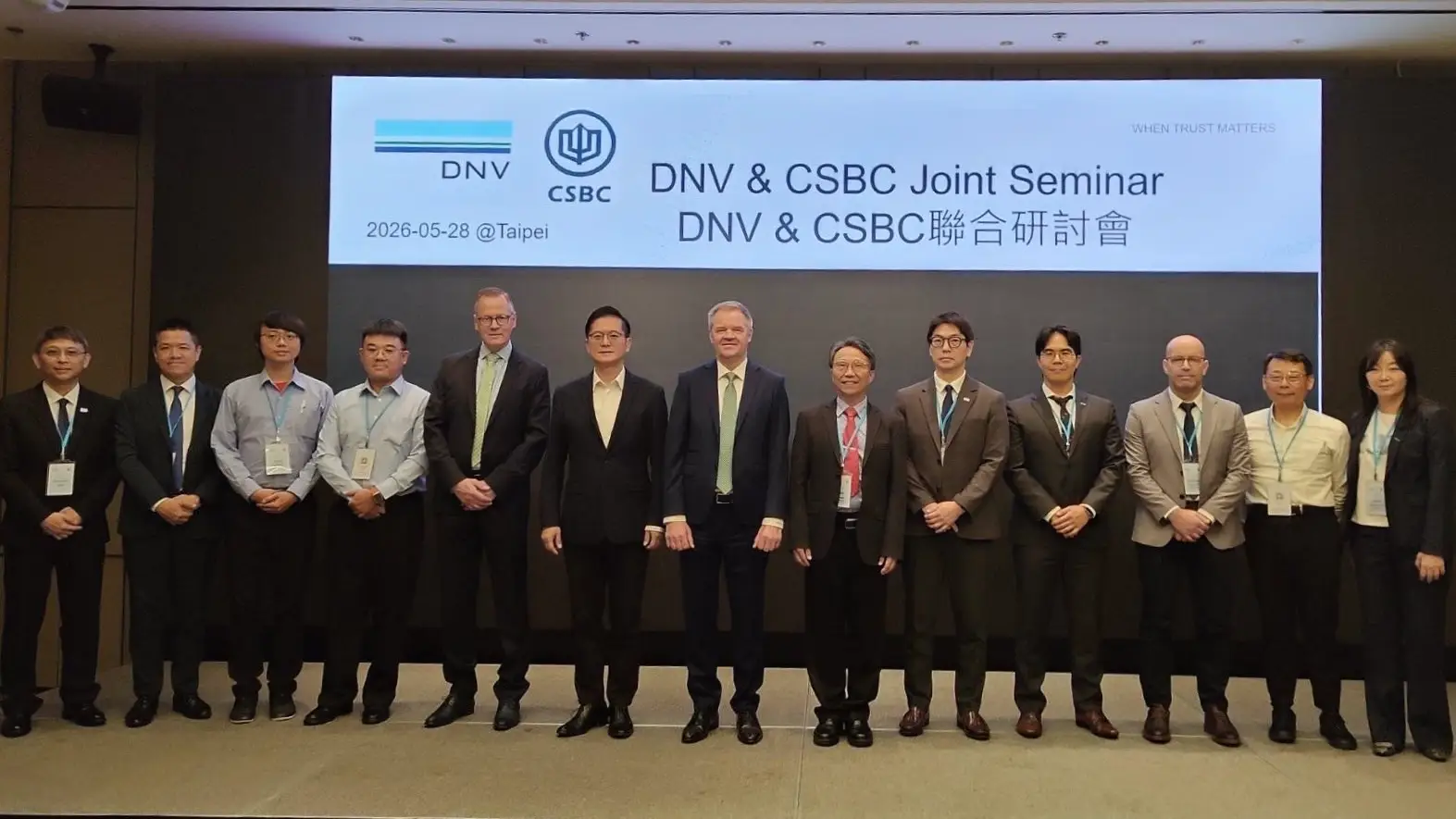
DNV Greater China President Norbert Kray (7th from left), CSBC President Kun-Tsung Tsai(8th from left), and Deputy Director-General Pin-Chuan Chen of the Maritime and Port Bureau, MOTC (6th from left), pose for a group photo with the speakers at the event.
(Source: CSBC)
CSBC Corporation, Taiwan (TWSE: 2208, hereinafter "CSBC"), in collaboration with DNV, the world's leading maritime classification society, today (28) hosted the 2026 DNV & CSBC Joint Seminar at Courtyard by Marriott Taipei Downtown. The event brought together leaders from the shipping industry, shipbuilding experts, representatives from academia and industry, as well as members of the media. Participants engaged in in-depth discussions on energy transition and maritime technological innovation amid the global drive toward net-zero emissions.
CSBC noted that the global shipping industry is rapidly transitioning from the era of conventional fossil fuels to a new age of low-carbon and zero-carbon energy solutions. Amid this transformation, shipbuilders and equipment suppliers are required not only to comply with increasingly stringent international regulations, but also to demonstrate advanced capabilities in vessel design, system integration, and practical onboard implementation. At this critical juncture, DNV has become a key strategic partner in CSBC's efforts to advance the development of green and smart vessels by its extensive experience in classification and certification, world-class technical expertise, and deep insight into the future of sustainable shipping.
Recently, CSBC in collaboration with DNV, has been commissioned by Wan Hai Lines to develop a new-generation 8,700 TEU high-efficiency container vessel. This project represents a significant milestone in Taiwan's shipbuilding industry and further underscores the deepening technical cooperation between CSBC and DNV.
The vessel series incorporates a range of advanced energy-saving designs, including a high-efficiency propeller, energy-saving rudder, rudder bulb, and pre-swirl duct, all of which contribute to improved propulsion efficiency and overall vessel performance. The design is also optimized to achieve energy efficiency design index (EEDI) compliance at -40% below the required baseline, demonstrating strong environmental performance.
In addition, the superstructure above the forecastle deck is integrated with a wind deflector design, effectively reducing wind resistance during navigation and further enhancing fuel efficiency.
In terms of hull structural design, the project adopts DNV's GeniE and Nauticus Hull systems to perform precise strength calculations and stress analysis for cargo hold structures under various loading conditions and complex sea states. This ensures a high level of structural safety and integrity at the design stage while significantly improving design accuracy and engineering efficiency.
Notably, the final two vessels in the series will be equipped with a methanol dual-fuel system, enhancing future fuel flexibility and enabling early adoption of alternative fuels as part of the industry's transition toward low-carbon energy solutions.
This collaboration not only demonstrates CSBC's engineering breakthrough in energy-efficient vessel design and integration, but also highlights DNV's strong international influence in supporting the maritime industry's journey toward net-zero shipping. At the same time, it reflects Wan Hai Lines' forward-looking commitment to developing a sustainable and green shipping strategy.
Looking ahead, CSBC will continue to place research and innovation at the core of its development strategy, with ongoing efforts in alternative fuel technologies, hydrodynamic optimization, intelligent monitoring systems, localized system integration, and low-carbon vessel development. These initiatives aim to further enhance vessel energy efficiency and reduce operational emissions.
CSBC will also continue to strengthen its collaboration with international organizations such as DNV, leveraging global technical expertise and certification capabilities to support shipowners in meeting increasingly stringent international maritime regulations and net-zero challenges. Through these efforts, CSBC seeks to advance Taiwan's shipbuilding industry toward a more sustainable future and deliver next-generation green and smart vessel solutions with stronger global competitiveness.
Source: CSBC
