

MOEA Launches Domestic Quadruped Robot R&D Platform to Strengthen Smart Inspection and Disaster Response Resilience
MOEA Launches Domestic Quadruped Robot R&D Platform to Strengthen Smart Inspection and Disaster Response Resilience
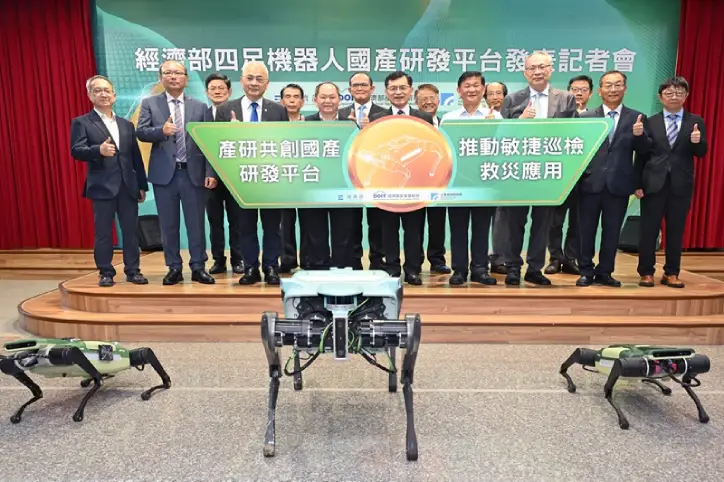
The Department of Industrial Technology (DoIT) under the Ministry of Economic Affairs (MOEA) hosted the Domestic Quadruped Robot R&D Platform Launch Press Conference, bringing together representatives from government, industry, academia, and research institutions to showcase the achievements of Taiwan's domestic quadruped robot R&D platform, highlighting the country's capabilities in indigenous intelligent robotics development, system integration, and real-world deployment.
Front row (left to right): Chih-Hsien Liang, Vice President of Compal Electronics; Jia-Yush Yen, President of NTUST; Pei-Zen Chang, President of the ITRI; Chung-Pin Chou, Deputy Director General of DoIT, MOEA; Chin-Tsang Ho, Deputy Minister of Economic Affairs; Wan-Yao Chien, Deputy Director-General of the NFA; Cheng-Lung Chen, Chairman of Solomon Technology; Yea-Ping Chen, Senior Vice President of Inventec; and Scott Chen, General Manager of the Energy and System Automation Business Group at TECO Electric & Machinery.
Back row (left to right): Jen-Yuan Chang, Director of ITRI's Mechanical and Mechatronics Systems Research Laboratories; Ching-Hai Lu, General Manager of the Taiwan Fire Technology Foundation; Jwu-Sheng Hu, Executive Vice President of ITRI; Mao-Chang Lin, Chairman of NEXCOM and NexCOBOT; Chien-Chang Liu, General Manager of Compertum Microsystems; and Kuan-Ming Li, Professor in the Department of Mechanical Engineering at NTU.
(Source: DoIT)
Taiwan's Department of Industrial Technology (DoIT) under the Ministry of Economic Affairs (MOEA) today held a press conference to unveil the Domestic Quadruped Robot R&D Platform, showcasing the achievements of the government-backed technology initiative. Supported by the ministry's technology development program, the platform was developed by the Industrial Technology Research Institute (ITRI) in collaboration with domestic industry, academia, and research partners.
The platform brings together leading Taiwanese companies, including Solomon Technology, Compal Electronics, Inventec, NexCOBOT, Compertum Microsystems, and TECO Electric & Machinery, resulting in the development of two domestically designed quadruped robot prototypes. The robots have successfully completed application demonstrations in underground culvert inspection, autonomous navigation and inspection, multi-robot collaborative operations, and firefighting and disaster response.
The achievement highlights Taiwan's capabilities in the independent development, system integration, and practical application of intelligent robotics. It also lays a solid foundation for building a domestic intelligent robotics ecosystem, enhancing industrial competitiveness, and strengthening national resilience.
MOEA Deputy Minister Chin-Tsang Ho said that artificial intelligence is evolving toward Physical AI, enabling AI systems to perform tasks in real-world environments. As a result, the robotics industry has become one of the key focus areas under Taiwan's National AI 10 Major Construction Projects. The establishment of the domestic quadruped robot R&D platform, led by ITRI in collaboration with industry, academia, and research institutions, demonstrates Taiwan's strengths in cross-disciplinary technologies, including mechanical engineering, perception systems, semiconductors, dynamic balance control, and system integration.
Ho noted that quadruped robots have significant potential for deployment in high-risk missions such as fireground reconnaissance and inspections of confined underground spaces. Their applications can also be extended to manufacturing, public services, critical infrastructure, and national defense. As complex disasters become increasingly frequent, the open platform is expected to accelerate domestic R&D and application validation while promoting the adoption of robotics technologies across traditional industries and small and medium-sized enterprises (SMEs), thereby enhancing the overall value of Taiwan's industrial sector.
He added that the government will continue to provide resources and opportunities to cultivate young talent in strategic priority fields, encouraging the next generation to contribute to future key industries and further strengthen Taiwan's innovation capabilities while fostering the development of a globally competitive emerging robotics industry.
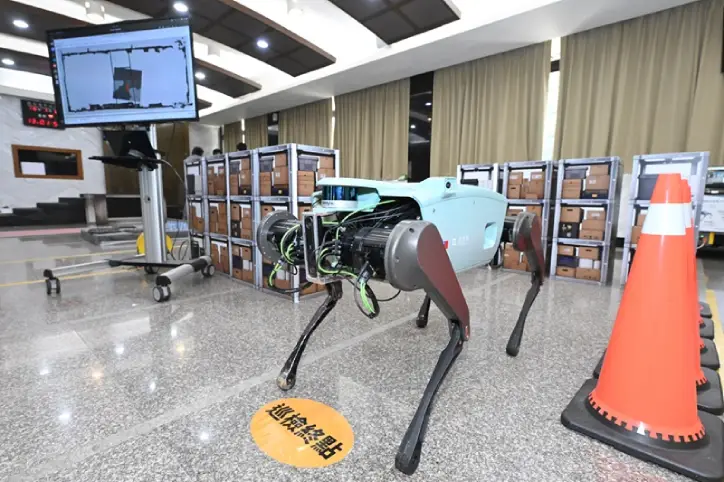
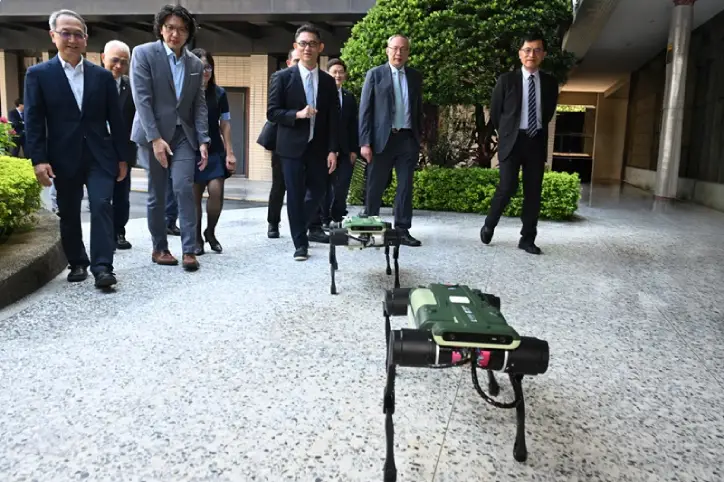
Taiwan's domestically developed quadruped robot integrates LiDAR, autonomous localization, and obstacle avoidance technologies, enabling it to independently perform inspection tasks in unknown environments.
(Source: DoIT)
The DoIT said that quadruped robots, with their exceptional terrain adaptability, serve as a key platform for Physical AI applications. They can assist frontline personnel in carrying out high-risk missions, including hazardous-area reconnaissance, infrastructure inspection, and supply transportation, helping reduce operational risks while enhancing public safety and national resilience.
The press conference also featured demonstrations of Taiwan's domestically developed quadruped robotics platform and its diverse applications, including underground culvert inspection, autonomous navigation and inspection, and multi-robot collaborative transport.
In the underground culvert inspection demonstration, which simulated an underground utility tunnel operated by Taiwan Power Company (Taipower), the quadruped robot showcased its ability to climb stairs, crawl through confined spaces, perform low-angle visual inspections, and travel long distances. These capabilities enable it to access narrow and rugged environments to conduct equipment inspections and read instrument gauges.
The autonomous navigation and inspection demonstration integrated technologies such as LiDAR-based mapping, autonomous localization, obstacle avoidance, and dynamic balancing, enabling the robot to independently complete inspection tasks in previously unknown environments.
Meanwhile, the multi-robot collaboration demonstration featured three quadruped robots working together to transport critical supplies, highlighting capabilities in coordinated multi-robot operations, task allocation, and logistics support. These technologies are expected to see broad applications in inspection, disaster response, and logistics in the future.
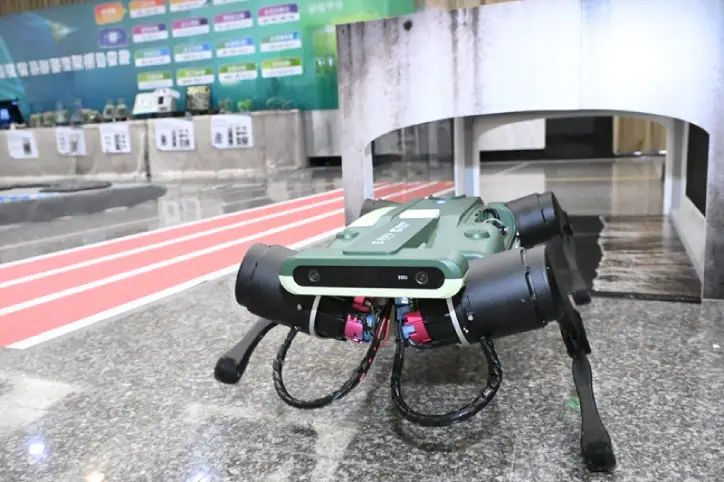
A domestically developed quadruped robot conducts equipment inspections in underground culvert , demonstrating autonomous capabilities such as stair climbing, navigation through confined spaces, and equipment inspection.
(Source: DoIT)
ITRI President Pei-Zen Chang said that intelligent robotics has become a key driver of industrial transformation and upgrading, while establishing indigenous technologies and a comprehensive industrial ecosystem is fundamental to Taiwan's development of the intelligent robotics sector.
Chang noted that most international quadruped robots have traditionally adopted closed architectures, making it difficult for domestic companies to access core control technologies and customize system integration and functional development based on specific application requirements. With support from the MOEA's technology development program, ITRI has taken on the role of technology developer and platform integrator, building Taiwan's independent technological capabilities across the entire value chain — from components, modules, and systems to AI software.
ITRI has also brought together domestic industry partners across key technology areas, including complete robot manufacturing, system integration, controllers, LiDAR sensors, joint motors, batteries, inertial measurement units (IMUs), AI software, and firefighting applications, to jointly establish an open intelligent robotics R&D platform.
Through platform sharing, modular integration, and application validation, the platform aims to accelerate product development and technology commercialization, encourage more industries to participate in innovative intelligent robotics applications, and gradually build a globally competitive made in Taiwan (MIT) intelligent robotics ecosystem.
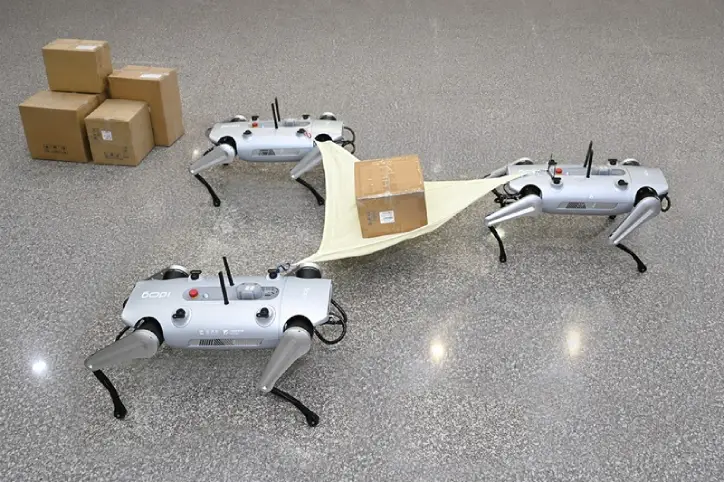
Three domestically developed quadruped robots collaborate to transport supplies, demonstrating coordinated multi-robot operations, task allocation, and logistics support capabilities.
(Source: DoIT)
Notably, the domestically developed quadruped robot has become Taiwan's first robotic firefighting dog to successfully complete functional verification. It passed testing conducted by a third-party certification body accredited by the National Fire Agency (NFA), demonstrating its ability to perform fireground reconnaissance in a simulated fire environment with temperatures reaching 100°C at the ceiling while operating just two meters from the fire source. The successful validation confirms the robot's capability to operate in high-temperature, high-risk environments. In the future, it is expected to assist firefighters by conducting on-site reconnaissance and collecting real-time situational data, improving both the safety and efficiency of disaster response operations.
To further enhance the quadruped robot's autonomous decision-making and environmental adaptability, the platform leverages the NVIDIA Taipei-1 supercomputer and the NVIDIA Omniverse simulation platform, supported through a program of the DoIT. More than 4,000 virtual robotic dogs can be trained simultaneously using AI in a large-scale simulation environment. By adopting a "simulate first, deploy later" approach, the platform strengthens the robots' autonomous adaptation capabilities while accelerating AI model development, validation, and deployment.
The MOEA is advancing the Domestic Quadruped Robot R&D Platform under the theme of "Co-Developing Innovation with Industry." By leveraging ITRI's cross-disciplinary R&D expertise and Taiwan's domestic supply chain, the initiative is working with industry partners to develop key locally produced robotic modules and prototype systems. Front row (left to right): Chih-Hsien Liang, Vice President of Compal Electronics; Hung-Hsiang Yu, Division Director of ITRI's Mechanical and Mechatronics Systems Research Laboratories; Chao-Chung Kuo , Director General of DoIT, MOEA; Cheng-Lung Chen, Chairman of Solomon Technology; and Chin-Tsang Ho, Deputy Minister of Economic Affairs.
(Source: DoIT)
The press conference brought together representatives from the firefighting community, academia, and industry to witness the unveiling of the domestic quadruped robot R&D platform. Attendees included NFA Deputy Director-General Wan-Yao Chien, Taiwan Fire Technology Foundation General Manager Ching-Hai Lu, National Taiwan University of Science and Technology President Jia-Yush Yen, National Taiwan University Department of Mechanical Engineering Professor Kuan-Ming Li, as well as industry leaders including Solomon Technology Chairman Cheng-Lung Chen, Compal Electronics Vice President Chih-Hsien Liang, Inventec Senior Vice President Yea Ping Chen, TECO Electric & Machinery Energy and System Automation Business Group General Manager Scott Chen, NEXCOM and NexCOBOT Chairman Mao-Chang Lin, and Compertum Microsystems General Manager Chien-Chang Liu.
Their participation underscored the close collaboration among government, academia, research institutions, and industry in advancing Taiwan's indigenous quadruped robotics technologies, accelerating the commercialization of applications in intelligent inspection, public safety, firefighting and disaster response, and smart logistics.
Source: Department of Industrial Technology (DoIT)(English translation by EnergyOMNI)
