

Ocean Affairs Council Launches Taiwan's First Marine Surface and Underwater Vehicle Competition as 12 Teams Gather to Advance Smart Ocean Technologies
Ocean Affairs Council Launches Taiwan's First Marine Surface and Underwater Vehicle Competition as 12 Teams Gather to Advance Smart Ocean Technologies
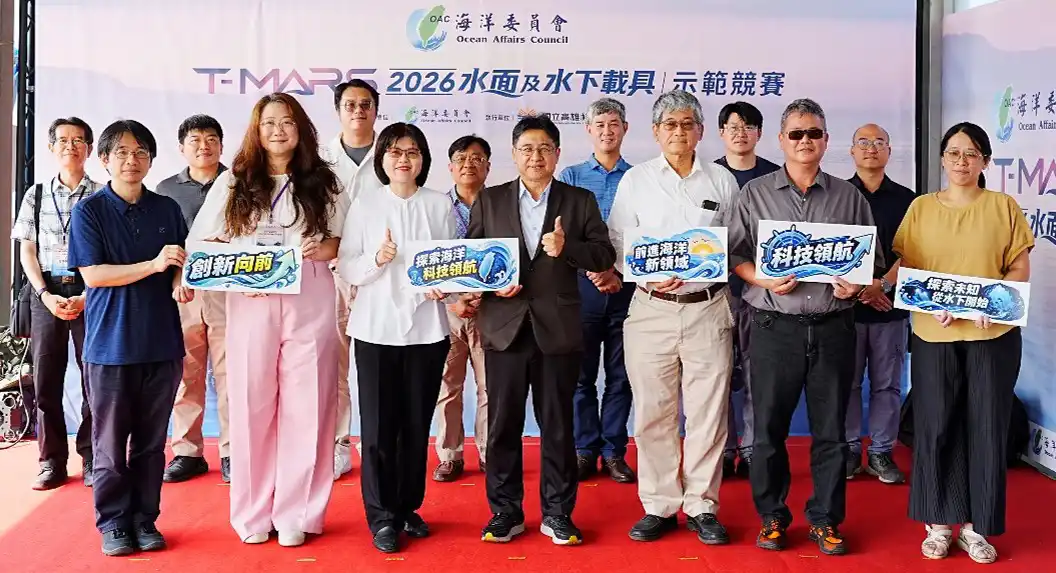
Group photo at the opening ceremony of the "2026 Taiwan Maritime and Aquatic Remotely-operated Systems" (T-MARS)
(Front row, from second left) Wen-Ling Hong (洪文玲), Associate Professor at National Kaohsiung University of Science and Technology (NKUST)|Li-Ying Lin (林麗英), Director of the OAC's Department of Science, Technology, Culture and Education|Hsin-Hsiu Wu (吳欣修), Administrative Deputy Minister of the OAC|Jen-Hwa Guo (郭振華), Professor of National Taiwan University (NTU)|Yung-Yu Chen (陳永裕), Professor of National Cheng Kung University (NCKU)|Wan-Jen Huang (黃婉甄), Professor of National Sun Yat-sen University (NSYSU).
The Ocean Affairs Council (OAC) held the opening ceremony of the "2026 Taiwan Maritime and Aquatic Remotely-operated Systems" (T-MARS) at Lover's Wharf in Xingda Harbor, Kaohsiung, on October 31, officially launching the inaugural event. The competition brought together 12 leading marine technology teams from across Taiwan, showcasing the country's strong capabilities in marine technology innovation, research and development, and interdisciplinary practical applications.
In the opening remarks, OAC Administrative Deputy Minister Hsin-Hsiu Wu (吳欣修) emphasized that the ocean is a vital arena for Taiwan's development. Advanced vehicle technologies and professional expertise are essential for a wide range of activities, from marine environmental monitoring and resource surveys to maritime safety and smart ocean governance. Surface and underwater vehicles not only extend humanity's capacity to explore the ocean while significantly reducing operational risks and costs, but also serve as essential tools for advancing smart ocean governance.
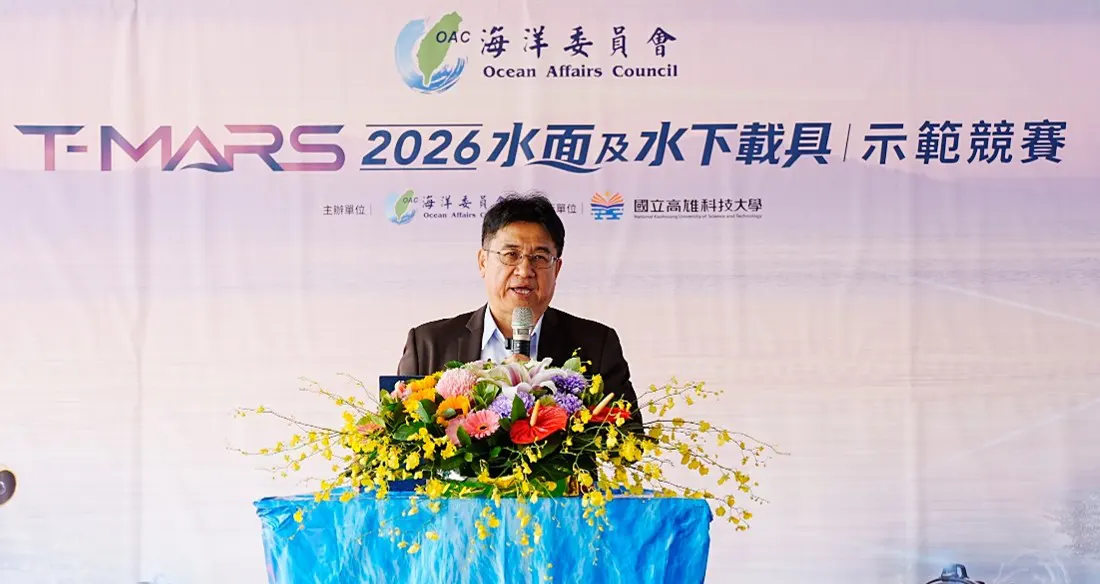
Hsin-Hsiu Wu (吳欣修), Administrative Deputy Minister of the OAC, delivers remarks.
Wu expressed hope that the inaugural competition would provide a practical platform for young students to exercise their creativity, validate technologies, and exchange experiences. By engaging in real-world applications, students can strengthen their capabilities in system integration and problem-solving, laying a solid foundation for Taiwan's independent marine technology research and development.
4 Competition Categories Showcase the Diverse Applications of Smart Ocean Technologies
The competition features 4 categories: Unmanned Surface Vehicles (USVs), Remotely Operated Underwater Vehicles (ROVs), Autonomous Underwater Vehicles (AUVs), and Human-powered Submarines. These categories encompass different propulsion systems, control mechanisms, auxiliary functions, and mission requirements.
Participating teams will demonstrate their technological achievements and the feasibility of real-world applications through field operations, technical reports, and collaborative tasks. The competition will also assess their practical capabilities in technology integration, operational stability, and on-site problem-solving.
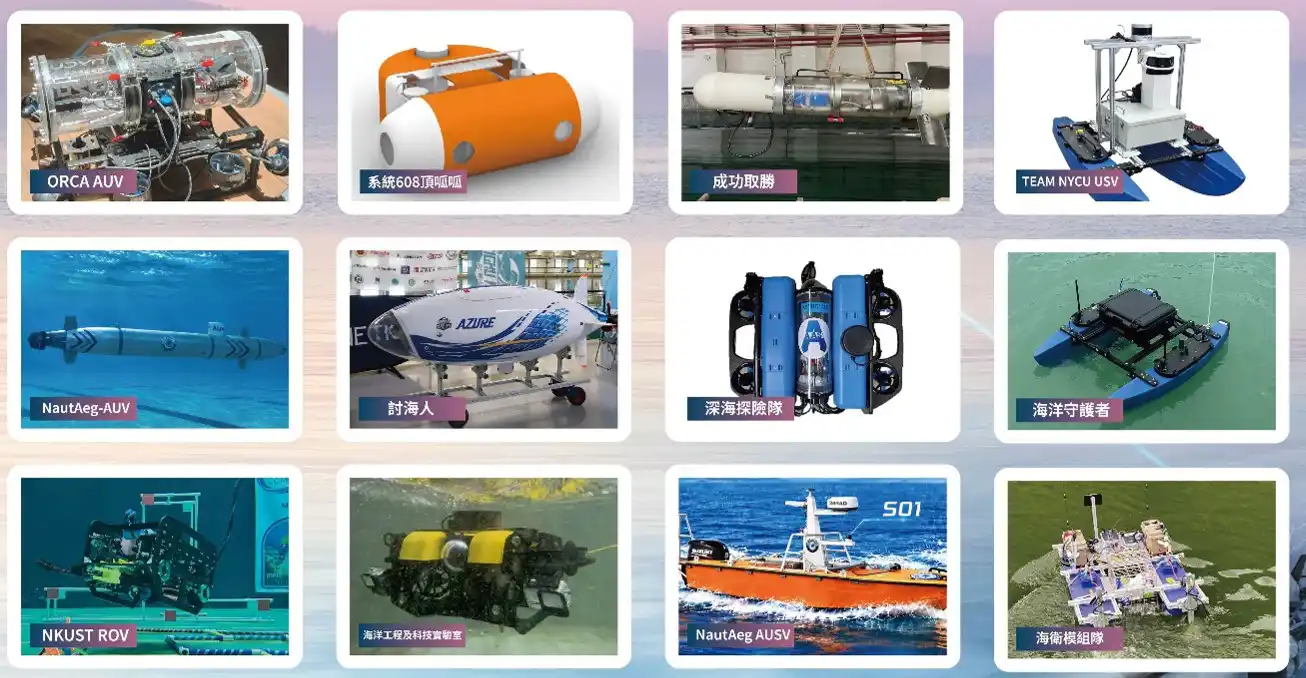
Illustrations of the underwater vehicles developed by the 12 participating university teams.
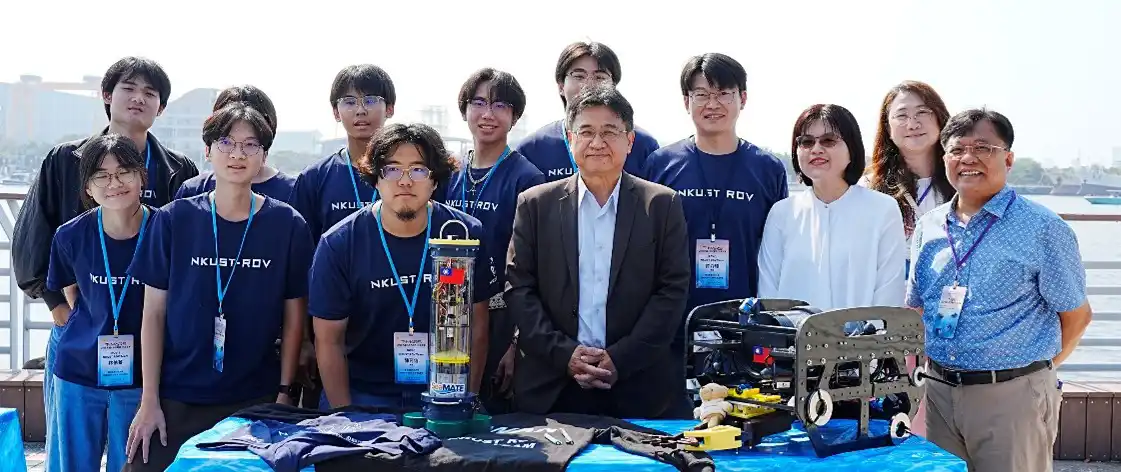
The NKUST ROV Team from NKUST introduces its independently developed ROV. Integrating propulsion, electrical power, control systems, and a mechanical gripper, the vehicle can operate remotely underwater and retrieve objects.
Behind every competition entry lies the dedication and hard work of students and faculty, from initial concept development and technological research to repeated testing and refinement. Entries range from self-developed remotely operated underwater vehicles and autonomously controlled surface and underwater vehicles to independently designed single-person wet-type human-powered submarines.
These projects demonstrate the student teams' commitment to vehicle architecture design and safety performance. Based on different mission requirements and innovative concepts, teams have also developed diverse applications, including environmental monitoring, data collection, and underwater target identification.
Notably, many teams have incorporated environmentally friendly materials and AI into their designs, exploring the development of marine vehicles that combine smart innovation with environmental sustainability. Their efforts demonstrate that technological advancement is not solely about engineering breakthroughs, but also about responsibility and commitment to protecting the marine environment.
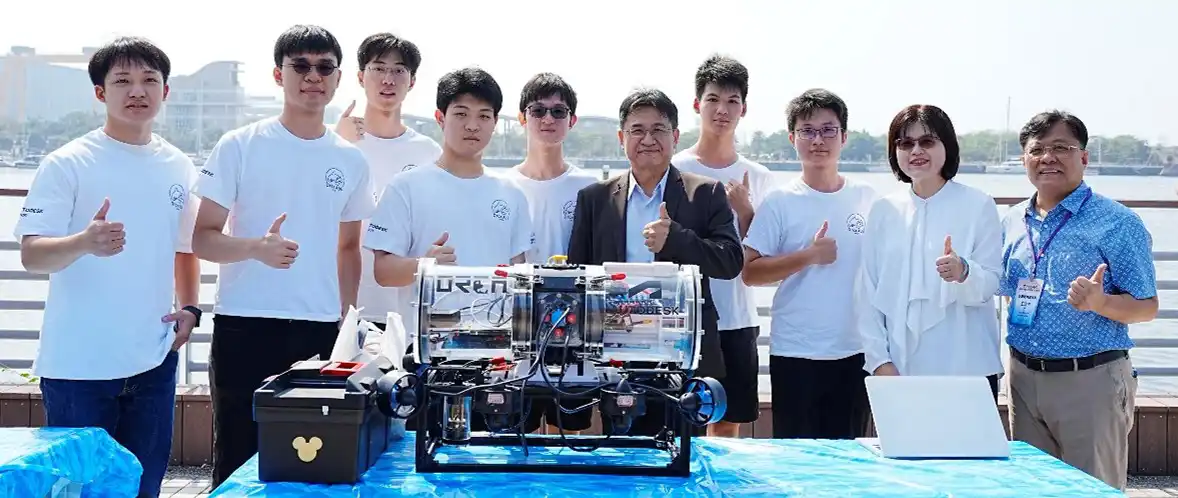
The ORCA AUV team from National Yang Ming Chiao Tung University (NYCU) presents its independently developed AUV. Equipped with machine vision and a downward-facing camera to identify underwater surroundings, the vehicle can perform missions autonomously and switch to ROV mode when required.
Fostering Industry-Academia Collaboration and Nurturing Young Talent to Advance Smart Ocean Development
he OAC stated that the competition serves not only as a platform for showcasing research and development capabilities, but also as an important opportunity for students and faculty from diverse academic and professional backgrounds to exchange ideas and learn from one another.
The initiative aims to gradually establish domestic mechanisms for hands-on marine technology development, performance validation, and interdisciplinary collaboration, ensuring that individual contributions and innovative ideas receive recognition. It also seeks to harness the younger generation's enthusiasm and creativity in marine science and technology as a driving force for continued innovation and future applications.
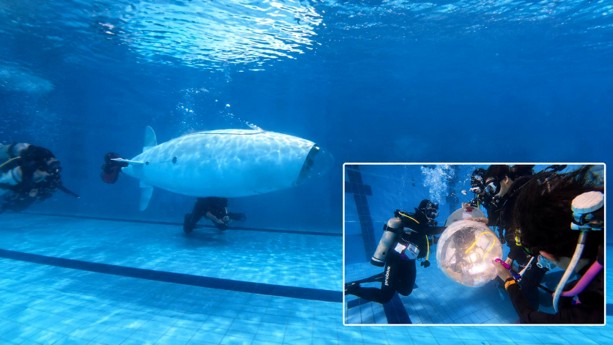
A human-powered submarine developed by National Cheng Kung University (NCKU) conducts an underwater navigation demonstration.
The award ceremony will be held on November 3 at the International Convention Center Tainan (ICC Tainan), alongside the "2026 Taiwan Marine Tech & Unmanned Robotics Expo" (MATURE Taiwan). Outstanding competition entries will be showcased, while industry-academia exchanges will be organized to strengthen connections between marine technology research outcomes and industrial needs.
The OAC expressed particular appreciation to National Kaohsiung University of Science and Technology, all co-organizing institutions, participating experts and scholars, and industry, academic, and research partners for their collective contributions. Looking ahead, the OAC will continue to uphold its commitment to nurturing talent from the ground up and fostering mutually beneficial industry-academia collaboration. Through strengthened talent development, key technology research, and diverse activities and exchange platforms, the council aims to generate sustained momentum for Taiwan's independent marine technology innovation and the development of smart ocean technologies.
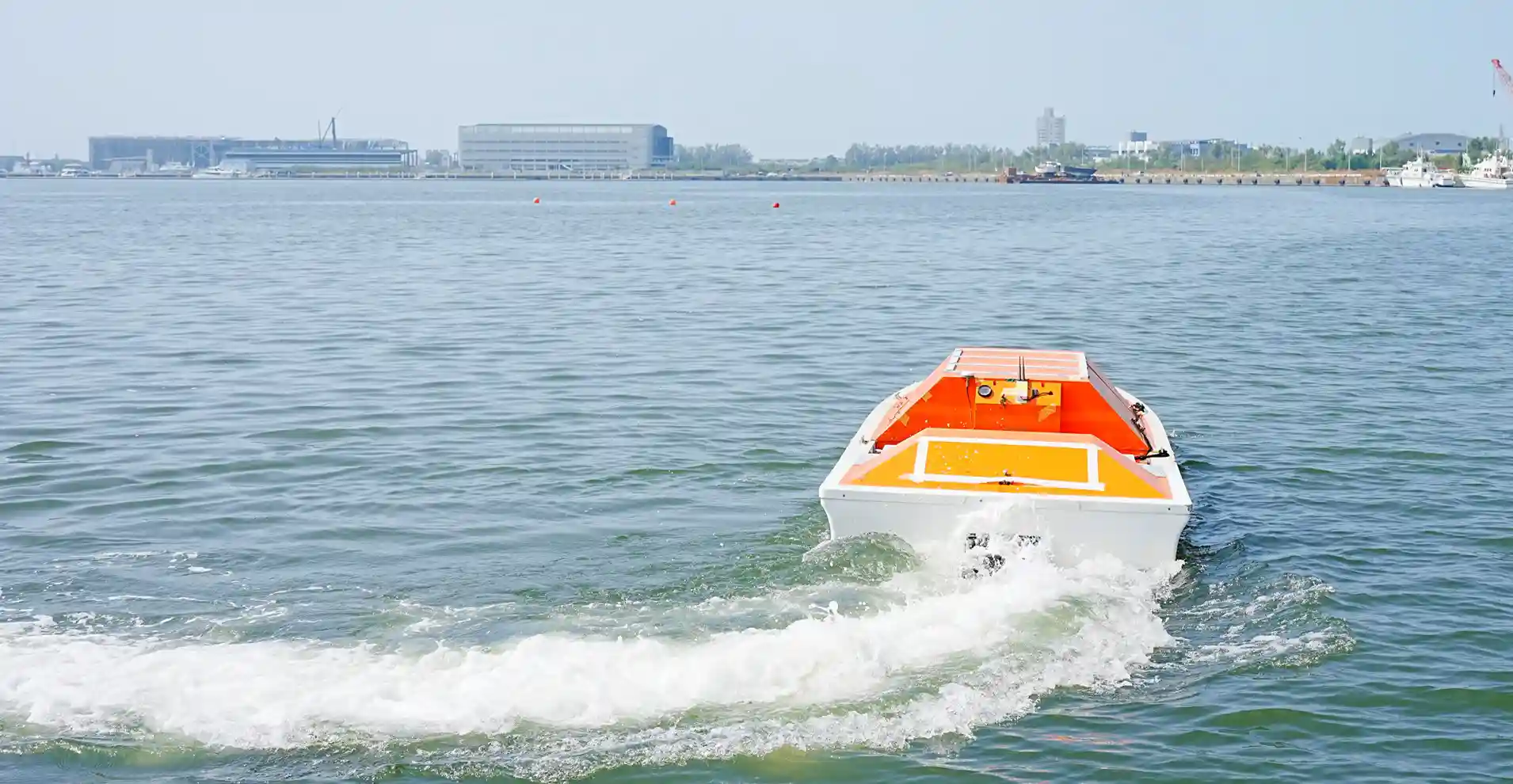
The Center for Smart and Energy-Efficient Marine Vehicles at National Cheng Kung University (NCKU) is conducting an at-sea demonstration of its domestically developed Autonomous Unmanned Surface Vehicle (AUSV), showcasing advanced marine technologies such as autonomous navigation and precision path tracking.
Source: The Ocean Affairs Council (OAC)
Compilation & Ttranslation: EnergyOMNI
