

Corporate Green Power Demand Could Exceed 35 Billion kWh by 2030, Shifting Focus to Supply-Demand Optimization
Corporate Green Power Demand Could Exceed 35 Billion kWh by 2030, Shifting Focus to Supply-Demand Optimization
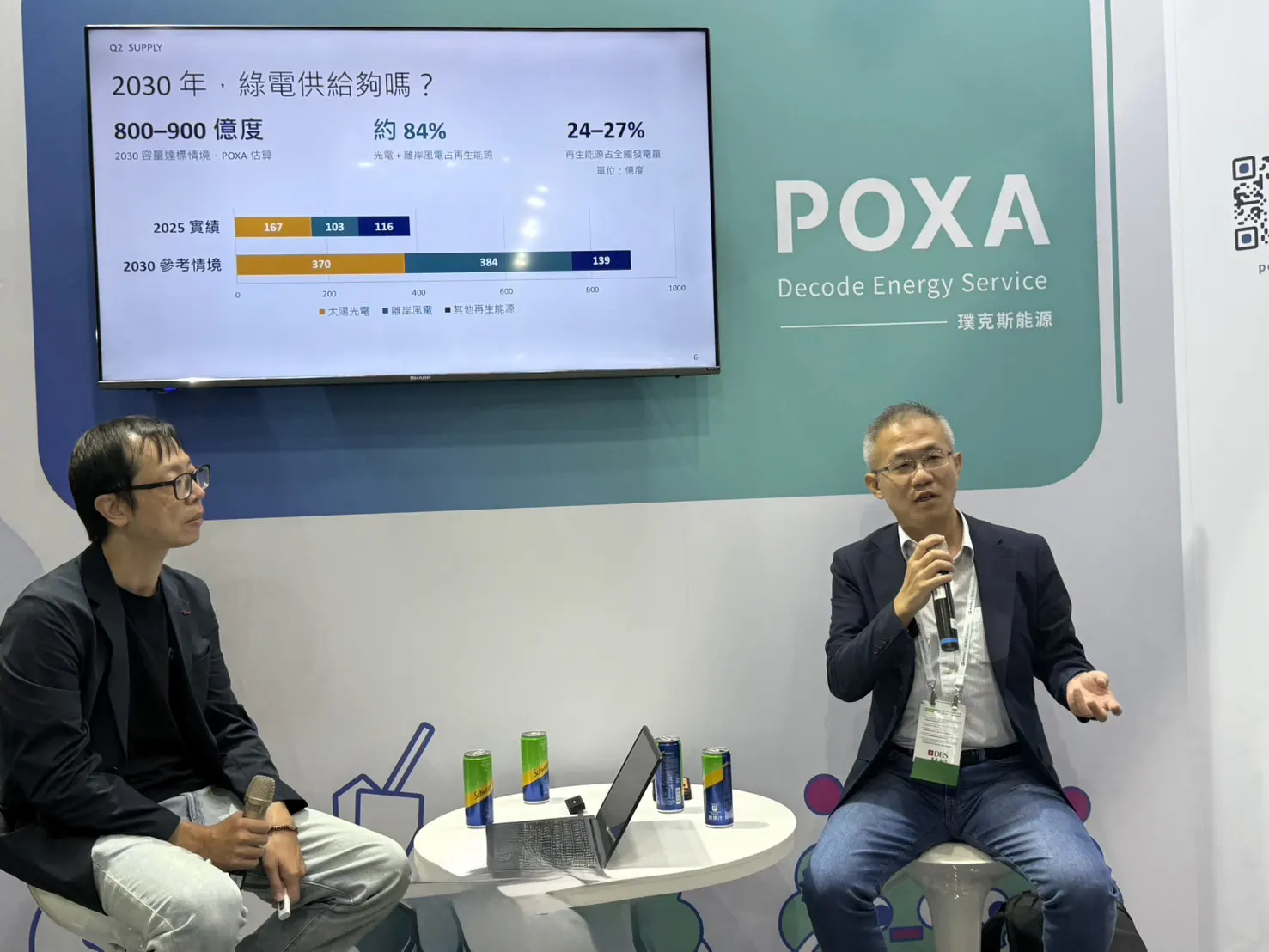
(From Left) Shih-Ying Chang, editor-in-chief of the POXA Weekly|Hsiang-Yi Yu, General Manager at Chenya Energy
Chenya Energy (辰亞能源), a subsidiary of Japan's Marubeni Corporation (丸紅集團), and POXA Energy (璞克斯能源), a provider of energy technology solutions, held a discussion at 2026 Net-Zero Taiwan & Energy Taiwan under the theme, "Is Green Electricity Really in Short Supply? Does Buying Enough Guarantee Sufficient Supply?" The discussion examined the next phase of challenges facing corporate renewable energy procurement, covering projected supply and demand in 2030, the allocation of solar and wind power, and the management of surplus electricity.
According to statistics, direct and wheeling-based renewable electricity supplied to corporate customers totaled approximately 6 billion kWh in 2025. By 2030, corporate demand for green electricity is projected to reach between 25 billion and 35 billion kWh, more than four times the current level. As procurement volumes expand, businesses face the growing challenge of aligning green electricity supply more precisely with actual consumption, reducing surplus electricity and improving utilization efficiency.
Shih-Ying Chang, editor-in-chief of the POXA Weekly newsletter, noted that as corporate green electricity procurement continues to expand, data and digital systems will become essential foundations for energy management. By gaining greater visibility into electricity generation and consumption, businesses can improve supply-demand matching, allocate green electricity more accurately, and use it more efficiently.
Combining its experience in renewable energy development, power sourcing, and corporate electricity sales with POXA Energy's systems and data analytics capabilities, Chenya Energy is expanding its role beyond supplying green electricity to helping businesses manage it. By monitoring generation and consumption data and optimizing the alignment between different power sources and electricity demand, the company aims to help businesses pursue increasingly ambitious renewable energy targets while improving green electricity utilization, ensuring supply stability, and managing energy costs.
Chenya Energy General Manager Hsiang-Yi Yu said, "The next phase of the green electricity market will place greater emphasis on integration and management capabilities. Chenya will continue to expand beyond renewable energy development, investment, and electricity sales into corporate energy management and integrated services. We aim to help customers improve green electricity utilization efficiency and become a long-term partner supporting their sustainable development."
【About Chenya Energy (辰亞能源)】
Chenya Energy Co., Ltd. is a wholly owned Taiwanese subsidiary of Japan's Marubeni Corporation and a key hub for the group's renewable energy investments in Asia. The company specializes in the development, construction, and O&M of large-scale solar power plants. It also provides green electricity sales and CPPA services to advance Taiwan's energy transition and accelerate the development of a low-carbon society.
Guided by the group's core principles of "Global Vision, Local Commitment, and Sustainable Growth," Chenya Energy has developed ground-mounted, rooftop, and floating solar photovoltaic projects since its establishment in 2014. With cumulative investments approaching NT$10 billion, the company has an installed capacity of 332 MW and generates more than 439 million kWh of electricity annually, continuing to provide Taiwan with a stable and traceable source of green electricity.
Source: Chenya Energy
Compilation & Ttranslation: EnergyOMNI
