

Ocean Affairs Council Opens Applications for Three Maritime Testing Sites to Support Unmanned Vehicle Industry Development
Ocean Affairs Council Opens Applications for Three Maritime Testing Sites to Support Unmanned Vehicle Industry Development
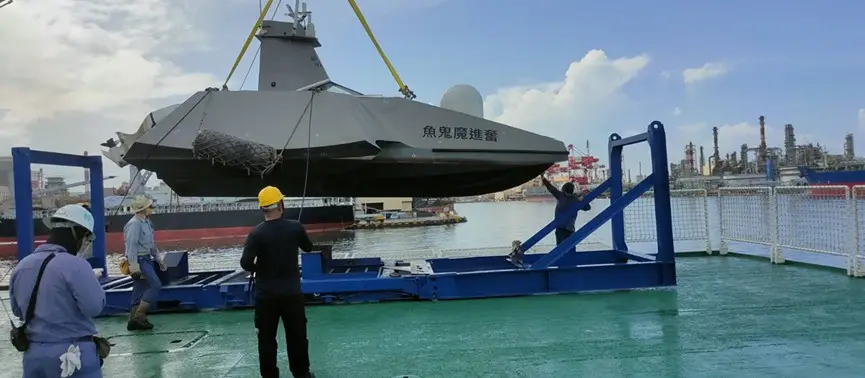
Unmanned Vehicle Hoist Test
(Source: CSBC Coporation, Taiwan)
To implement the national "Smart Ocean" strategy and accelerate the development of Taiwan's indigenous research and development (R&D) capabilities in Unmanned Surface Vehicles (USVs) and Unmanned Underwater Vehicles (UUVs), the Ocean Affairs Council (OAC) emphasized that advancing marine technology innovation is essential to strengthening national capabilities and enhancing maritime resilience.
The OAC has been actively addressing R&D challenges faced by industry, academia, and research institutions. Following nearly a year of intensive interagency consultations and stakeholder engagement, the OAC's applications to establish three designated "Marine Testing Sites for Unmanned Surface and Underwater Vehicles" in Suao, Yilan; Budai, Chiayi; and Linyuan, Kaohsiung, have completed the review process conducted by the Ministry of the Interior (MOI), including public consultation, and have officially received establishment permits.
The three designated testing sites cover a combined marine area of 14,207 hectares. Their establishment will not only significantly streamline the application procedures for maritime testing, but also ensure the safe operation of the testing areas while promoting the harmonious coexistence of existing maritime activities, including navigation, fisheries, and recreational uses. This marks a significant milestone in advancing Taiwan's marine technology development and smart ocean governance.
Urgent Need to Overcome Barriers to Maritime Testing and Administrative Procedures Through Cross-Sector Collaboration
The OAC stated that unmanned surface and underwater vehicle technologies have experienced rapid global growth in recent years, with wide-ranging applications in marine scientific research, ecological monitoring, offshore wind farm operations and maintenance, and maritime security patrols and law enforcement.
However, the successful transition of these vehicles from R&D to commercialisation depends largely on their ability to undergo operational testing and validation in real-world maritime environments. In the past, industry, government, academia, and research institutions were often constrained by the limited size, water depth, and current conditions of ports or inland waters. This prevented them from evaluating the optimal performance of the vehicles and the true impacts of waves and currents.
Furthermore, Taiwan's surrounding waters are characterised by heavy maritime traffic and overlapping uses, including fishing activities, recreational activities, marine protected areas, shipping routes, and submarine cables and pipelines. As a result, stakeholders have long faced difficulties in identifying the appropriate application procedures and responsible authorities. The approval process is often time-consuming, and there is frequently no single government agency able to provide clear authorisation. These challenges have significantly hindered the timely advancement of industrial R&D and the commercialisation of unmanned maritime technologies.
OAC Coordinates with 31 Government Agencies and Stakeholders to Reach a Multi-Party Consensus
To address these challenges comprehensively and promote the development of an industrial cluster, the OAC took the initiative in 2025 to establish the Guidelines for the Use of Maritime Areas for Surface and Underwater Unmanned Vehicle Testing Activities (辦理水面/水下無人載具海域測試活動空間使用指引), setting out a standard framework for operational procedures.
Beginning in January 2026, the OAC further leveraged its role in coordinating and integrating maritime affairs. It conducted a comprehensive assessment of the actual needs of various stakeholders and drew on international experience in establishing advanced testing facilities. The OAC also proactively convened multiple rounds of consultations involving 31 government agencies, organisations, and existing maritime stakeholders. These included authorities responsible for shipping, fisheries, information security, national defence, and industrial development, as well as unmanned vehicle research and development institutions and local fishermen's associations.
The OAC stated that it aims to secure all necessary site approvals for three major testing sites in Suao, Yilan; Budai, Chiayi; and Linyuan, Kaohsiung, ahead of the formal implementation of the Act on Strengthening National Defense Self-Reliance and Developing Unmanned Systems Industry, thereby meeting the growing domestic demand for maritime testing without delay.
Following the OAC's continued efforts in communication and coordination, the entire review process has been completed and approval for the designated locations of the maritime testing areas has officially been granted.
At the same time, the OAC has formally issued the Directions for Applications and Use of Testing Sites for Surface and Underwater Unmanned Vehicles, which establish the procedures and requirements for organisations applying to the OAC to conduct testing activities. Applicants are required to submit relevant inspection and certification documents covering vessel safety and information security. They must also notify the relevant authorities before conducting tests, issue Notices to Mariners, and arrange on-site safety and security measures throughout the testing operations.
Furthermore, the OAC will hold application procedure briefing sessions in Kaohsiung, Budai in Chiayi, and Suao in Yilan to help prospective applicants understand the relevant requirements and procedures.
These initiatives mark a historic milestone in the development of Taiwan's maritime testing environment for surface and underwater unmanned vehicles.
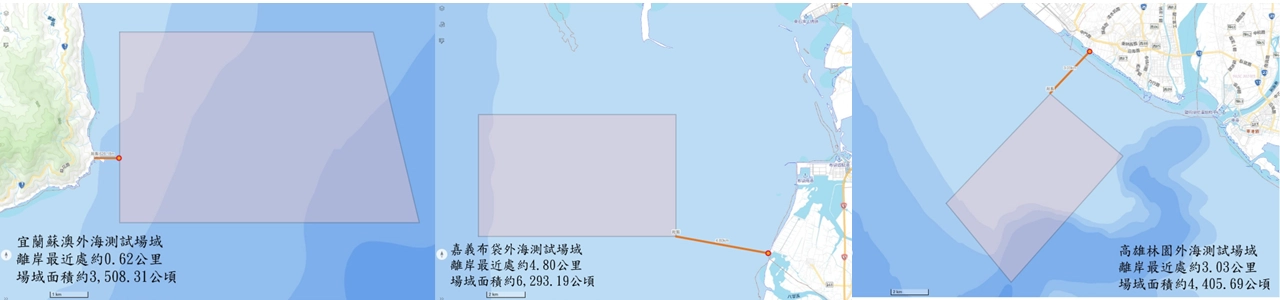
Marine Testing Sites for Unmanned Surface and Underwater Vehicles
(Source: Ocean Affairs Council)
Consolidating Relevant Information and Officially Accepting Applications
The OAC emphasised that safeguarding national security, public order, and maritime safety is at the core of its mission, while promoting innovation in marine technology is essential to strengthening Taiwan's national capabilities.
To facilitate testing applications for the three designated sites, the OAC has completed the site approval procedures and identified relevant contact points to provide applicants with the necessary assistance and information. These measures significantly reduce the administrative burden on organisations seeking to conduct tests, allowing industry, government, academia, and research institutions to focus on technological breakthroughs and performance validation.
Looking ahead, the OAC will continue to uphold its commitment to balancing three key priorities: ecological sustainability, maritime security, and industrial development. It will serve as a strong partner and steadfast supporter of the academic and research communities and industry in advancing marine technology, guiding Taiwan towards becoming a smart ocean nation with strong global competitiveness.
Application forms and relevant documents can be downloaded from the Unmanned Vehicle Testing Site Application webpage on the OAC's official website: https://gov.tw/VKh
Source: Ocean Affairs Council (OAC)
Compilation & Translation:EnergyOMNI
