

EnergyOMNI | No.009-From Cities to Grids: Compute-Driven Demand as a Catalyst for Behind-the-Meter Storage Deployment and Public–Private Virtual Power Plant Governance
Embarking on the Era of Net Zero Sustainability
EnergyOMNI | No.009-From Cities to Grids: Compute-Driven Demand as a Catalyst for Behind-the-Meter Storage Deployment and Public–Private Virtual Power Plant Governance
-
Publication Date2026/01
-
LanguageTraditional Chinese and English
-
Pages100
-
Supported Devices


Detailed Introduction
Contents
|Editor's Note
|Contents
|Series Introduction
|Cover Story
Energy Transition 2.0 Is Not a Vision — It Is Now Operational How Behind-the-Meter Virtual Power Plants Will Become a Pivotal Force in the New Compute Era
Interview with Ming-Hsin Kung, Minister of Ministry of Ecnomic Affairs (MOEA)
Energy Transition 2.0: Rethinking Power Governance — Chun-li Lee: The Real Key Lies in Dispatch, Institutions, and Markets
Interview with Chun-li Lee, Director General of Taiwan's Energy Administration
Location, Location, Location Space × Place × Location: Principles and Challenges of Energy Management
Interview with Wen-Sheng Tseng, Chairman of Taiwan Power Company
|Feature Column
From Power Cables to Energy Storage: How Tun Green Power Is Redefining Global Storage Standards with Heavy-Electrical Engineering — A Taiwan-Style Solution
Interview with Mei-Ling Lin, Chairperson of Tun Green Power
From Power Dispatch to Asset Lifecycle Management How BILLION Watts Is Carving a Non- Replicable Path in the Energy Storage Industry
Interview with Pedersen Chen, Chairman of BILLION Watts, and Elaine Chen, General Manager of BILLION Watts
From Chemical Reactions to Physical Laws: Carving Out a Non-Mainstream Path for Energy Storage
Interview with Edward Ding, Chairman of Power8 Tech
Turning AI from Algorithms into an Asset Governance Expert Johnson Hsieh's talking on the True Logic Behind Industrial AI Deployment
Interview with Johnson Hsieh, Founder and CEO of Chimes AI
Bringing the Energy Transition Back to the People Philippa Tsai on From Yunus' Three Zeros Vision to the Next Mile of Social Virtual Power Plants
Interview with Philippa Tsai, Chairperson of the Taiwan Yunus Foundation
|Feature Report
Weather as Fuel: Inside Australia's Energy Transition and the System Architecture of Virtual Power Plants
Xin-En Wu
|Event Summary
Inaugural Taiwan Maritime Engineering Influence Forum Convenes Positioning Maritime Engineering as the Cornerstone of Taiwan's Path Toward a "Competent Maritime Nation"
Xin-En Wu
|View in Spotlight
The Future of Negotiation Theatre: An Innovative Convergence of Art, Social Science, and Public Engagement
Interview with Chih-Yuan Yang, Assistant Professor of the International College of Innovation, National Chengchi University
|EnergyOMNI Exclusive Colum
Hydrogen Has Not Lost Momentum— It Has Been Misplaced Why the "Hydrogen Ladder" Has Sparked a Global Debate, and What It Means for Taiwan
Martin Tzou, Jong-Shun Chen
Main Theme Of This Issue

EnergyOMNI|Publishing of Chinese-English Bilingual Magazine
If Issue No. 8 of EnergyOMNI explored how Taiwan has begun its journey from an island economy to a trusted global partner— leveraging energy technologies, industrial capabilities, and institutional expertise to become a country the world needs and international partners rely on—then Issue No. 9 turns to a deeper and more consequential question:
When energy transition is no longer merely a direction or a vision, but has fully entered the deep waters of institutions, dispatch, and governance, how—through different perspectives and ongoing construction—do we collectively approach what may constitute an “optimal solution”?
"Energy Transition 2.0 is not a vision—it is an operational reality."
This is not simply a headline, but a reflection of the moment Taiwan is now living through.
As renewable energy penetration accelerates, AI and new computing power fundamentally reshape electricity demand, and industries grow increasingly dependent on stable and predictable energy supply, the energy debate has shifted decisively. It is no longer about how much power to generate or which technologies to adopt, but about governance at its most fundamental level:
Who dispatches the system? How should institutions be designed? How should markets be structured? And how, amid rising complexity and uncertainty, can stability, resilience, and fairness be maintained?
This issue of EnergyOMNI unfolds precisely within this broader context.
From Shared Vision to Institutional Choice
Over the past several years, Taiwan has gradually built social consensus around energy transition. Yet the true challenge has never been consensus itself—it lies in choosing the path forward.
Through its cover story and core interviews, this issue approaches the same question from multiple angles: When energy transition becomes an everyday system operation, does Taiwan possess the institutional capacity required to sustain it?
We extend our sincere gratitude to Minister of Ministry of Economic Affairs (MOEA) Ming-Hsin Kung, Director General Chun-li Lee of the Energy Administration, and Taipower Chairman Wen-Sheng Tseng for sharing their insights on these critical issues.
From Minister Kung's discussion of the operational logic behind Energy Transition 2.0, to Director General Lee’s assertion that “the real key lies in dispatch, institutions, and markets,” and Chairman Tseng’s reframing of energy management as fundamentally an issue of spatial governance—these conversations do not offer a single policy prescription. Instead, they collectively outline a power governance blueprint that is actively being restructured.
Within this blueprint, electricity is no longer treated merely as a commodity, but as a public system requiring careful governance. Energy transition, in turn, is no longer an engineering project alone—it is a long-term test of national institutional capacity.
The Rise of the Behind-the-Meter Era: Virtual Power Plants, Energy Storage, and Asset Governance
As energy transition enters deeper institutional waters, technology begins to challenge existing frameworks, while institutions, in turn, redefine the role of technology.
This issue places particular emphasis on the interrelationship between behind-the-meter resources, virtual power plants, and energy storage as assets. These resources—often distributed and located at the edges of the grid—are increasingly becoming critical pillars of system resilience.
From Tun Green Power Chairperson Mei-Ling Lin redefining international energy storage standards through heavy-electrical engineering; to BILLION Watts Chairman Pedersen Chen and General Manager Elaine Chen viewing energy storage as an asset requiring lifecycle management; to Power8 Tech Chairman Edward Ding returning to physical laws to challenge chemical battery orthodoxy; and Chimes AI founder Johnson Hsieh transforming AI into a tool for asset governance and risk management—these cases collectively point to a clear shift:
Taiwan's energy industry is moving from an equipment-oriented paradigm toward one centered on systems and resilience.
Energy Transition Must Belong Not Only to Markets, but to Society
Institutional deepening, however, remains incomplete if it is confined solely to technology and engineering.
This issue therefore also focuses on often-overlooked yet essential actors: social virtual power plants, vulnerable electricity users, public participation, and the reintegration of energy transition into everyday life. Drawing from Muhammad Yunus' "Three Zeros" vision, Philippa Tsai reminds us that energy transition loses its legitimacy if it becomes detached from social equity.
Hydrogen Is Not Cooling—It Has Been Misplaced
In global energy discourse, “hydrogen cooling off” has become a recurring media narrative. This issue’s special column challenges that assumption at its core.
Hydrogen's true difficulty does not stem from technological failure, but from the misalignment between application scenarios and policy expectations. When hydrogen is overburdened as a universal substitute energy source, it inevitably appears expensive, inefficient, and impractical. Yet when repositioned within industrial processes, long-term decarbonization pathways, and high-temperature applications, hydrogen remains an indispensable piece of the puzzle.
This is precisely why the "Hydrogen Ladder" has sparked intense international debate—not to reject hydrogen, but to force governments to confront a critical question: Which sectors genuinely warrant hydrogen, and which should be honestly excluded?
For Taiwan—where land, energy, and cost constraints are particularly acute—misplacing hydrogen would only drain policy momentum. Properly positioned, however, it may still represent one of the few energy options with long-term strategic value under Energy Transition 2.0.
Weather as Fuel: When Institutions Become the True Technology
If institutions lie at the heart of Energy Transition 2.0, Australia’s electricity market represents one of the world’s earliest and most instructive testing grounds.
In systems where renewable penetration has reached levels at which weather itself becomes fuel, power generation grows increasingly volatile and difficult to forecast. Traditional electricity systems—built around centralized generation and singular dispatch logic—are no longer sufficient.
This issue's field report on Australia’s electricity market does not present a success story, but an unvarnished reality: a system defined by pressure, trial and error, institutional recalibration, and an acute reliance on governance capacity.
For Taiwan, these lessons are not hypothetical future scenarios— they are approaching realities.
Standing on the Ocean: Maritime Engineering as a Test of National Governance
If land-based power system governance tests a nation’s capacity for coordination and dispatch, then maritime engineering serves as the critical test of whether Taiwan truly possesses ocean governance capability.
The Forum was not merely an industry gathering, but a clear signal. Taiwan has begun to recognize that offshore wind and marine energy development are not simply energy issues—they encompass ports, vessels, engineering capacity, supply chain resilience, legal frameworks, and marine spatial governance as an integrated national undertaking.
Forum participants repeatedly emphasized that if offshore wind is treated only as a question of megawatts and capacity targets, Taiwan will remain merely a transit point for international EPC contractors. But if marine zones are viewed as arenas for building maritime engineering capability, port systems, vessels, and institutional experience, then the maritime engineering sector becomes the force that truly enables Taiwan to stand on the ocean.
This marks the transition of “maritime nationhood” from slogan to governance reality—not declaring ownership of the sea, but demonstrating the capacity to use, manage, and assume responsibility for it.
Negotiation Is Not an Obstacle—It Is Governance Capacity
As energy and engineering move offshore, the challenges confronting the state extend beyond weather and technical complexity to include diverse, often conflicting, yet equally legitimate social perspectives.
The offshore wind negotiation theatre developed and examined by Professor Chih-Yuan Yang provides a critical missing piece in energy transition discourse: public negotiation itself is a form of governance capacity.
In this negotiation theatre, students and civic participants do not remain observers. They assume the roles of fishers, local residents, developers, government agencies, and environmental groups, entering a simulation with no predetermined answers. Conflicts are made explicit, positions laid bare, and negotiation moves beyond procedural hearings into substantive engagement with real-world constraints and value trade-offs.
This approach underscores a fundamental truth: the most difficult challenges are rarely technical feasibility, but how societies collectively shoulder, understand, and participate in decisions once technology is already viable.
As energy transition enters institutional deep waters, negotiation should not be viewed as resistance, but as a necessary institutional instrument—testing not persuasion, but society’s capacity to sustain rational dialogue amid conflict.
From Energy Transition to the Capacity to Govern From Island to Strategic Hub
When energy transition enters institutional deep waters, the question is no longer simply whether Taiwan should transition, but whether it can think through, govern effectively, and sustain the journey forward.
From virtual power plants and energy storage assetization, to the repositioning of hydrogen; from first-hand observations of Australia’s electricity market, to collective reflection on maritime engineering governance; and from technical systems to public negotiation— this issue does not offer a single answer.
Instead, it presents an emerging map of pathways and choices.
As energy transition moves from vision into reality, this is not merely a test of energy policy. It is a comprehensive test of governance capacity, engineering capability, and societal dialogue.
And we are already standing at the testing ground.
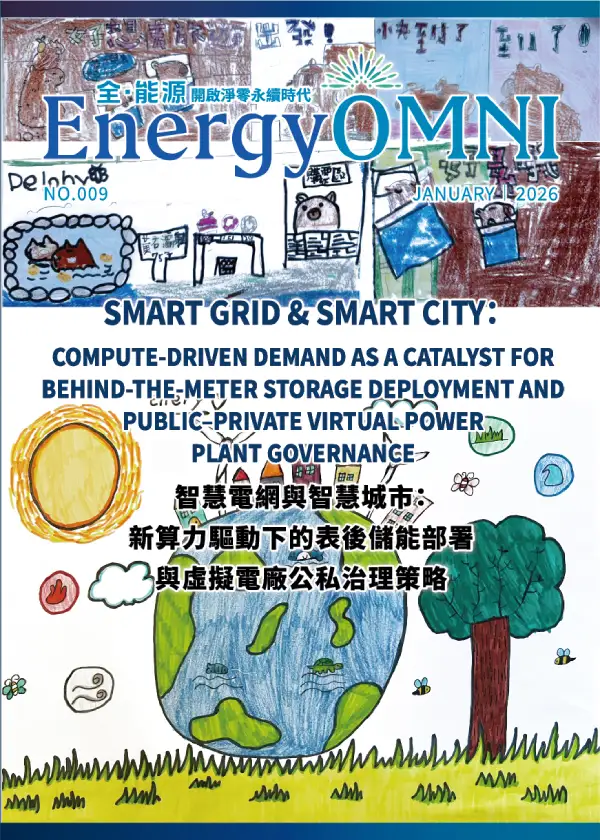
Featured Story on the Magazine Cover
Credit: Ellery Ho, Delphy Wang
Capybaras travel with dreams, exploring the world with joy.
Windmills sing, the sun smiles, the clouds dance, Earth jiggles like a jelly.
Forests and cities hold hands, animals and people grow together— living in the brightest home, our sparkling planet.
全.能源 EnergyOMNI
Our aspiration for EnergyOMNI is to provide readers with valuable trend insights and guide them in exploring future directions. The name "全.能源 EnergyOMNI" also reflects our commitment to achieving the vision of net zero from an energy perspective.
Others also viewed...
Offshore Engineering|Chapter 1-Project Start
 Offshore Engineering|Chapter 1-Project Start
EnergyOMNI|No.002-The Path to Sustainable Energy Management
 EnergyOMNI|No.002-The Path to Sustainable Energy Management
Offshore Engineering|Chapter 5-Wind Turbine Integration
 Offshore Engineering|Chapter 5-Wind Turbine Integration
EnergyOMNI|No.006-Resilience and De-Carbonization of Virtual Power Plants and Distributed Energy Sustainable Development Goals for the Renewable Energy Market in Taiwan
 EnergyOMNI|No.006-Resilience and De-Carbonization of Virtual Power Plants and Distributed Energy Sustainable Development Goals for the Renewable Energy Market in Taiwan
