

AI-driven Fossil Power Growth for Taiwan Semiconductors Risks 90 lives, Half a Billion USD in Economic Losses by 2030
AI-driven Fossil Power Growth for Taiwan Semiconductors Risks 90 lives, Half a Billion USD in Economic Losses by 2030

Taiwan's rapid expansion in AI-driven semiconductor manufacturing has led to a sharp increase in electricity consumption, intensifying reliance on fossil fuels and raising significant public health concerns. In 2024, power usage from AI semiconductor production surged by 350%, with state utility Taipower projecting that demand from the sector will exceed 5 GW by 2030.
Given that Taiwan's electricity grid remains heavily dependent on fossil fuels—comprising 34% coal and 44% natural gas in 2023—the environmental and health implications are substantial. A joint report by the Centre for Research on Energy and Clean Air (CREA) and Greenpeace estimates that continued reliance on fossil-based electricity could result in approximately 90 premature deaths, 19,000 work absences, and 277 cases of childhood asthma, alongside economic losses of up to USD 500 million by 2030.
The report further highlights that these projections assume renewable energy procurement remains at 2023 levels. However, accelerating renewable energy adoption among major semiconductor firms such as TSMC, Micron, and UMC could significantly mitigate these impacts. Such measures are estimated to prevent around 31 deaths annually and reduce economic losses by approximately USD 173 million per year.
Among these companies, TSMC stands out with the most ambitious renewable energy target—60% by 2030. The report indicates that TSMC alone could avoid nearly USD 97 million in annual health-related damages through an accelerated transition to renewable energy sources.
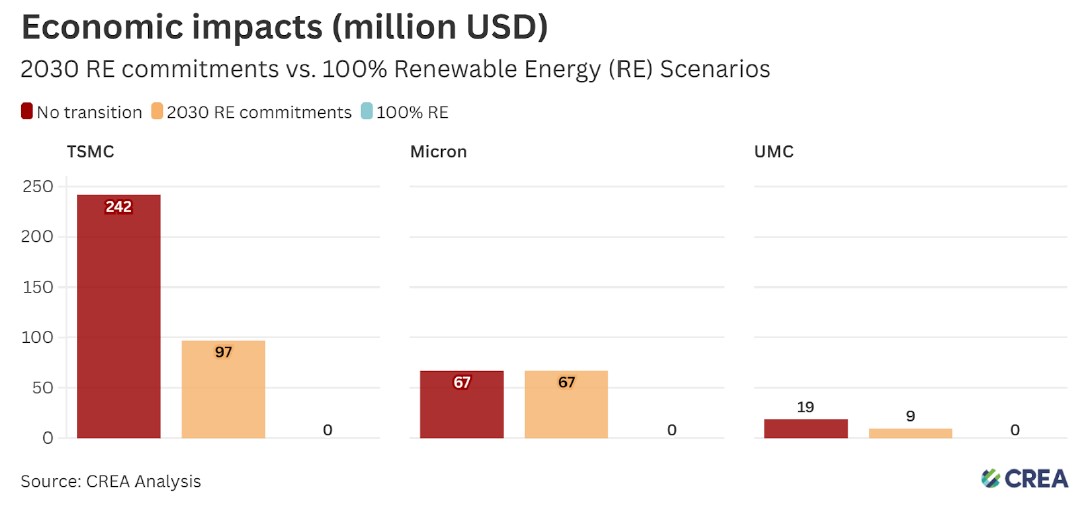
Economic impacts of Taiwan's EM industry in 2030, under 3 different renewable energy scenarios.
(Source: CREA)
Despite the semiconductor industry accounting for roughly one-quarter of Taiwan's total electricity demand, renewable energy still represents only a limited share of the national energy mix. Taiwan's Ministry of Economic Affairs (MOEA) has recently acknowledged that the country is unlikely to meet its target of generating 20% of electricity from renewable sources by 2026, underscoring the urgency of policy adjustments.
The report's authors urge both the Taiwanese government and semiconductor companies to strengthen their energy transition commitments by adopting a clear roadmap toward achieving 100% renewable energy (RE100) by 2030. They emphasize that immediate, incremental improvements can reduce air pollution, lower healthcare costs, and enhance grid resilience—particularly when combined with energy storage solutions.
"As Taiwan's power demand grows alongside the AI industry, transitioning away from fossil fuels offers clear public health and economic benefits," said Daniel Nesan, Analyst at CREA. "A full shift to renewable energy is not only essential for climate goals but also critical for safeguarding public health and sustaining economic growth."
Lena Chang, Campaigner at Greenpeace, added that Taiwan's semiconductor sector—while central to the global AI supply chain—must also take responsibility for its environmental impact. "By accelerating renewable adoption and investing in distributed energy and storage systems, the industry can both strengthen energy security and support communities affected by air pollution," she said.
