

Maritime Engineering Association Holds Annual General Meeting Promotes "Marine Team Taiwan" Initiative to Strengthen Industry Consensus
Maritime Engineering Association Holds Annual General Meeting Promotes "Marine Team Taiwan" Initiative to Strengthen Industry Consensus
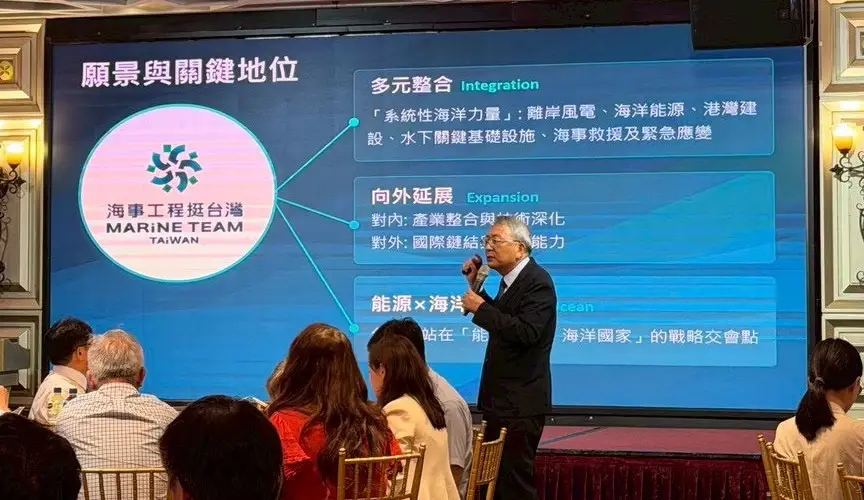
Robert Tseng, Chairman of NMEA, outlined the "Marine Team Taiwan" initiative, emphasizing that maritime engineering should be elevated as a strategic foundation for Taiwan's energy transition, ocean economy, national security, and industrial upgrading.
(Source: NMEA)
The National Maritime Engineering Association (NMEA) convened 2026 Annual General Meeting and Maritime Engineering Industry Networking Luncheon on May 29, bringing together representatives from government agencies, the energy sector, offshore wind supply chains, renewable energy service providers, and maritime engineering enterprises. Through keynote remarks, previews of upcoming association initiatives, expert presentations, and industry networking sessions, participants exchanged views on the future development of Taiwan's maritime engineering sector, with particular focus on offshore wind deployment, maritime safety management, subsea infrastructure security, and industrial upgrading.
Hosted by NMEA, the event welcomed distinguished guests from across the public and private sectors, including Hsin-Hsou Wu, Deputy Minister of the Ocean Affairs Council (OAC); Chung-Hsien Chen, Deputy Director General of the Energy Administration, MOEA; Viola Lin, Chairperson of the Taiwan Offshore Wind Industry Association (TOWIA); and Lucas Lin, Chairman of the Wind Energy Committee of the Green Energy Sustainability Alliance (GESA), alongside leaders from various maritime engineering and offshore wind-related industry associations.
The strong turnout reflected the growing interconnection between Taiwan's maritime engineering sector, national energy policy, offshore wind supply chains, and the broader renewable energy services ecosystem. Under the theme of fostering professional exchange and strengthening industry collaboration, the event underscored the importance of cross-sector engagement in enhancing Taiwan's industrial capabilities and competitiveness.
NMEA emphasized that continued collaboration through industry platforms is essential to supporting Taiwan's energy transition objectives and advancing the sustainable development of its ocean-based industries. By facilitating dialogue among stakeholders and promoting knowledge sharing across the maritime engineering community, the association aims to strengthen domestic capabilities and contribute to the long-term resilience and growth of Taiwan's marine economy.
The Annual General Meeting also introduced the "Marine Team Taiwan" Initiative, a strategic vision advocating that maritime engineering should no longer be viewed solely as a construction and support function within offshore wind development. Instead, it should be recognized as a critical pillar underpinning Taiwan's energy transition, ocean economy, national security, and industrial transformation.
The initiative emphasizes that, as an island nation, Taiwan's aspiration to become a true maritime nation requires the simultaneous development of three core pillars of maritime strength: a thriving shipping industry, indigenous shipbuilding capabilities, and a self-reliant maritime engineering sector. Building upon more than a decade of offshore wind development experience, Taiwan's maritime engineering industry is now positioned to support a broader range of strategic applications, including submarine cables, offshore substations, port infrastructure, marine renewable energy projects, maritime emergency response, rescue operations, and critical underwater infrastructure. These capabilities are expected to become a key competitive advantage, enabling Taiwan to strengthen its domestic industrial foundation while expanding its presence across the Asia-Pacific region.
The "Marine Team Taiwan" Initiative further defines maritime engineering as fulfilling three strategic functions. First, maritime engineering serves as the foundation of the energy transition. The development of offshore wind farms, submarine cable networks, offshore substations, and emerging marine energy technologies all depend upon highly integrated maritime engineering expertise and execution capabilities.
Second, maritime engineering serves as an essential extension of national security infrastructure. As power transmission, telecommunications networks, and energy supply systems become increasingly reliant on subsea assets, the security, reliability, and resilience of these critical infrastructures are directly linked to national security and societal stability.
Third, maritime engineering is a key enabler of industrial transformation and value creation. By integrating engineering design, manufacturing, project management, digital coordination, and offshore execution capabilities, Taiwan has the opportunity to move beyond its traditional role as a supplier of critical components and develop into a globally competitive exporter of high-value engineering solutions and maritime services.
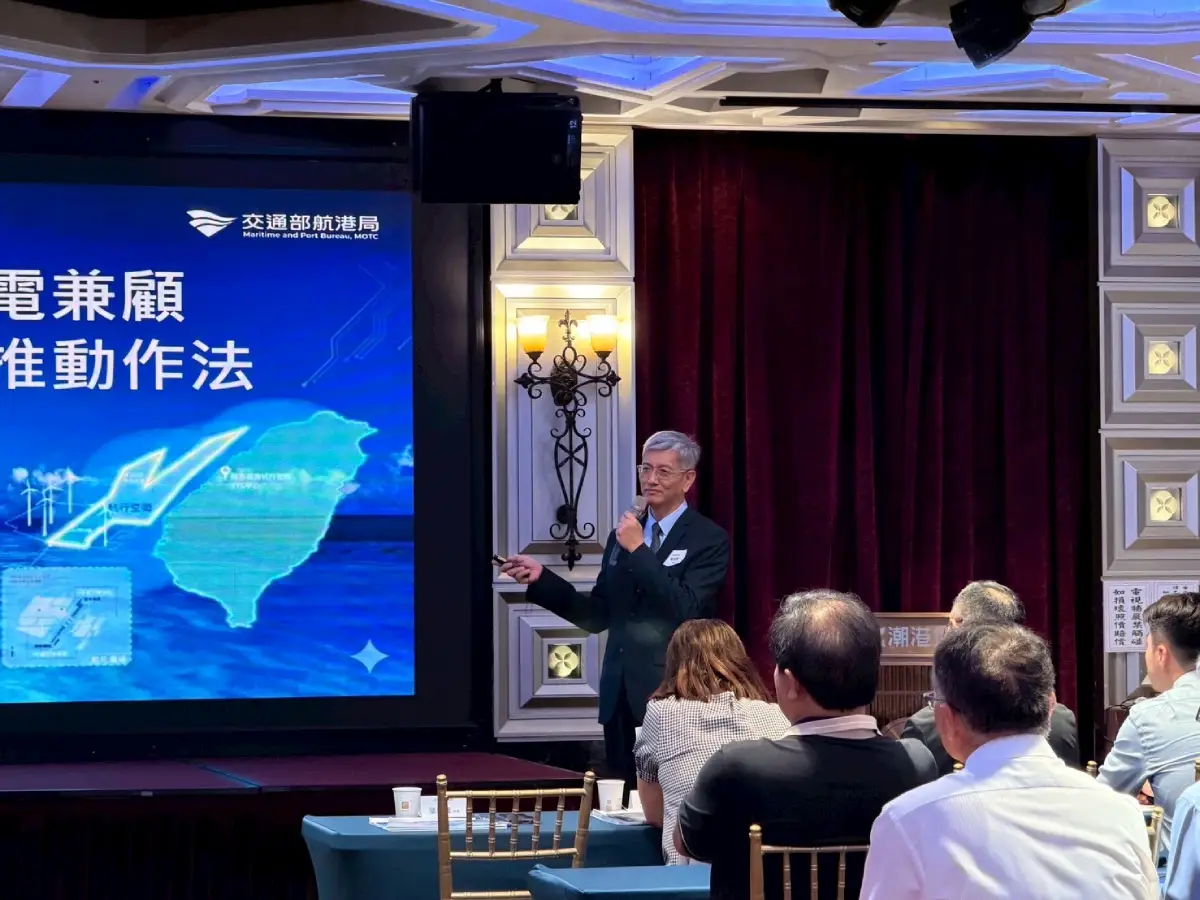
Director General Hsieh-Lung Yeh of the Maritime and Port Bureau under the MOTC highlighted key policy achievements, including Taiwan's offshore wind farm navigational space management framework, the development of offshore wind monitoring systems, and the establishment of maritime emergency response mechanisms.
(Source: NMEA)
During the featured keynote session, Hsieh-Lung Yeh, Director General of the Maritime and Port Bureau (MOPB) under the MOTC, shared insights into Taiwan's efforts to advance offshore wind development while maintaining maritime safety and supporting the sustainable growth of the shipping industry. His presentation outlined how Taiwan is strengthening maritime safety governance, preserving navigational order, and enhancing administrative coordination across maritime engineering activities.
As offshore wind projects increasingly occupy Taiwan's coastal waters, balancing the coexistence of wind farms with established shipping routes, fishing activities, commercial vessel traffic, and offshore construction operations has become a critical challenge. Effective coordination among these maritime stakeholders is essential to ensuring both the successful development of renewable energy infrastructure and the continued safety, efficiency, and resilience of Taiwan's maritime sector.
According to the MOPB, Taiwan has commissioned a dedicated Vessel Traffic Service (VTS) Operations Center to support offshore wind zone development, expanding its monitoring coverage from 673 km2 to approximately 4,000 km2. The system provides real-time vessel traffic monitoring, proactive surveillance and tracking, direct communication with vessels through radio and the Automatic Identification System (AIS), automated alerts for abnormal vessel movements, and coordination support between commercial shipping and fishing vessels. These capabilities enhance navigational safety within offshore wind development areas while facilitating the safe coexistence of multiple maritime users.
In parallel, the MOPB has advanced public-private collaboration initiatives to further strengthen offshore wind farm monitoring capabilities. Between 2025 and 2027, the Bureau plans to integrate AIS and radar data from six offshore wind farms to eliminate surveillance blind spots and improve situational awareness across Taiwan's offshore waters.
To date, AIS and offshore radar data from Ørsted's Greater Changhua 1 and 2 offshore wind farms have been successfully integrated into the monitoring system. Additional data connections are planned for the Hai Long 2, Changfang, Taipower Phase II, and Fengmiao offshore wind projects, creating a more comprehensive vessel traffic monitoring network throughout Taiwan's offshore wind development zones.
In the area of maritime emergency preparedness, the MOPB is also strengthening offshore wind farm emergency response capabilities through the deployment of a high-capacity ocean-going emergency towing vessel. Equipped with 10,000 horsepower (hp) and designed for operations in challenging sea conditions, the vessel will provide offshore rescue and emergency towing services to enhance navigational safety in Taiwan's waters.
An interim replacement vessel entered service at the Port of Taichung on May 10, 2026, while the purpose-built vessel is scheduled for delivery in September 2026. The project is intended to strengthen Taiwan's capability to assist distressed vessels, prevent maritime incidents from escalating into marine pollution events, and support the safe coexistence of offshore wind development and maritime operations.
Beyond infrastructure investments, the MOPB has also introduced a range of administrative and regulatory initiatives to support the offshore wind industry. These include the aviation and navigation business coordination meeting, enhanced seafarer training programs, regulatory assistance for foreign-flagged offshore work vessels, and the development of Aids to Navigation Management System.
These supporting policy measures demonstrate that offshore wind development is no longer solely an energy policy issue, but also a driver of broader system-wide upgrades in port and maritime regulation, offshore engineering capability, seafarer workforce development, emergency response capacity, and ocean governance.
The NMEA stated that Taiwan's maritime engineering industry has accumulated substantial experience through offshore wind development over the past decade. Looking ahead, the sector should further integrate industrial capabilities, broaden public recognition, provide policy recommendations, and strengthen international linkages. Through the "Marine Team Taiwan" initiative, the NMEA aims to elevate maritime engineering from a sector-specific issue to a national-level industrial narrative. This vision seeks to position Taiwan as a country that moves beyond energy import dependence to become a builder of integrated energy systems, evolves from a supplier of critical components to an exporter of engineering solutions, and transitions from an island economy to a truly maritime-oriented nation.
Amid rapid changes in the energy transition, subsea infrastructure security, offshore wind operations and maintenance, and the broader Asia-Pacific marine engineering market, maritime engineering has become an increasingly strategic industry that Taiwan cannot afford to overlook. Going forward, the NMEA will continue to serve as a platform for communication among government agencies, industry stakeholders, associations, and society, promoting industry consensus, policy advocacy, and international collaboration, with the goal of positioning the ocean as Taiwan's future strategic domain.
