

Ocean Affairs Council Successfully Transforms Marine Waste into Green Building Materials-NKUST Develops Marine Waste Fiber-Reinforced Shotcrete
Ocean Affairs Council Successfully Transforms Marine Waste into Green Building Materials-NKUST Develops Marine Waste Fiber-Reinforced Shotcrete
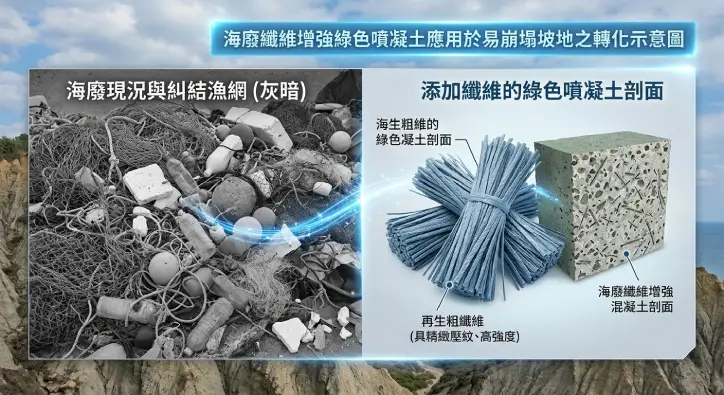
From Waste Fishing Nets to Structural Fibers
The National Kaohsiung University of Science and Technology develops marine waste fiber-reinforced shotcrete, integrating smart sensing to strengthen coastal disaster resilience.
The Ocean Affairs Council (OAC) announced key achievements from its science and technology grant programs on the 8th. A research team led by Professor Sung-Ching Chen (陳松靖) of the National Kaohsiung University of Science and Technology (NKUST), supported by the OAC, has successfully addressed the challenges posed by the fragile, erosion-prone mudstone badlands characteristic of southern Taiwan.
Under the project, "Research on Enhancing Resilience and Smart Monitoring of Collapsible Coastal Slopes Using Marine Waste Fiber-Reinforced Green Shotcrete" (海廢纖維增強綠色噴凝土應用於濱海易崩塌坡地之韌性提升與智慧監測研究), the team has developed an innovative way to recycle discarded fishing nets and polyethylene terephthalate (PET) bottles—2 persistent sources of marine pollution—into high-strength recycled structural fibers. These fibers are incorporated directly into green shotcrete, replacing conventional steel wire mesh, which is vulnerable to salt-induced corrosion.
The resulting material provides fragile coastal slopes with a flexible, rust-resistant protective layer, transforming marine waste into durable green
Replacing Steel with Plastic to Eliminate Corrosion and Strengthen Slope Protection
The project challenges the conventional practice of downcycling marine waste by processing discarded fishing nets into structural-grade coarse fibers using a specialized physical embossing technique. The resulting textured fibers bond tightly with cement, much like hook-and-loop fasteners, enabling plastic to replace steel and eliminating the long-standing problem of corrosion in coastal engineering. The project also introduces an innovative mesh-free construction method, eliminating the need for workers to install wire mesh manually at height and reducing associated safety risks.
When the marine waste fibers are mixed into concrete and sprayed onto slopes, they form millions of interconnected, three-dimensional reinforcement pathways within the material. In the event of earthquakes or rockfall impacts, these fibers provide a powerful bridging effect that helps hold cracks together, preventing them from propagating and preserving the integrity of the protective structure.
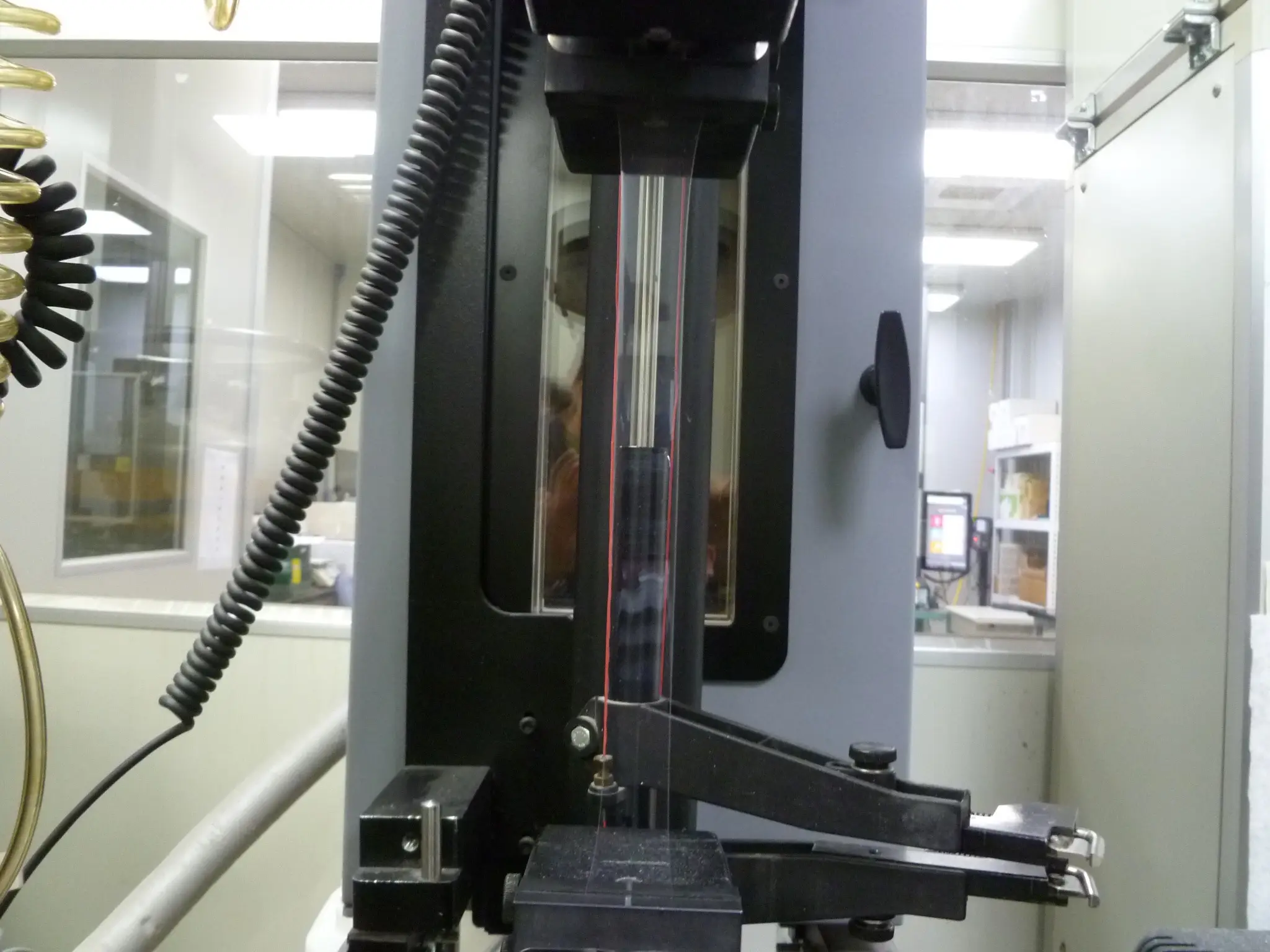
Tensile Test of PET Fiber (1 mm Thick)
Datafication-Driven Carbon Reduction and Long-Term Protection Advance the Blue Circular Economy
The project has demonstrated significant environmental and economic benefits. Each cubic meter of shotcrete can incorporate 6–10 kilograms of recycled marine plastic. By fully replacing conventional steel wire mesh, the technology can also reduce carbon emissions by approximately 27 kilograms per cubic meter.
Assessments indicate that the technology can extend the service life of coastal slope protection structures from the conventional 5 years to more than 12 years, while reducing life-cycle maintenance costs by over 20%. These benefits combine economic efficiency with long-term environmental sustainability.
Bringing Slopes to Life Through AIoT-Based Remote, Real-Time Smart Monitoring
The project incorporates digital transformation by developing impact-resistant smart monitoring nodes specifically designed for harsh environments. The nodes feature a dual-layer shock-absorbing enclosure, similar to a black box, protecting precision sensors from the intense impact of high-pressure shotcrete application and allowing them to be safely embedded within the structure.
The embedded sensors function like health trackers for coastal slopes. Using low-power wide-area network (LoRa) technology, they continuously transmit real-time data on subtle slope deformations and tilt-related changes around the clock. Management authorities can monitor conditions anytime and anywhere through a mobile APP or cloud-based dashboard. This technology upgrades conventional slope protection from a visible physical barrier to an intelligent defense system that not only protects slopes but also provides real-time insight into their structural condition.
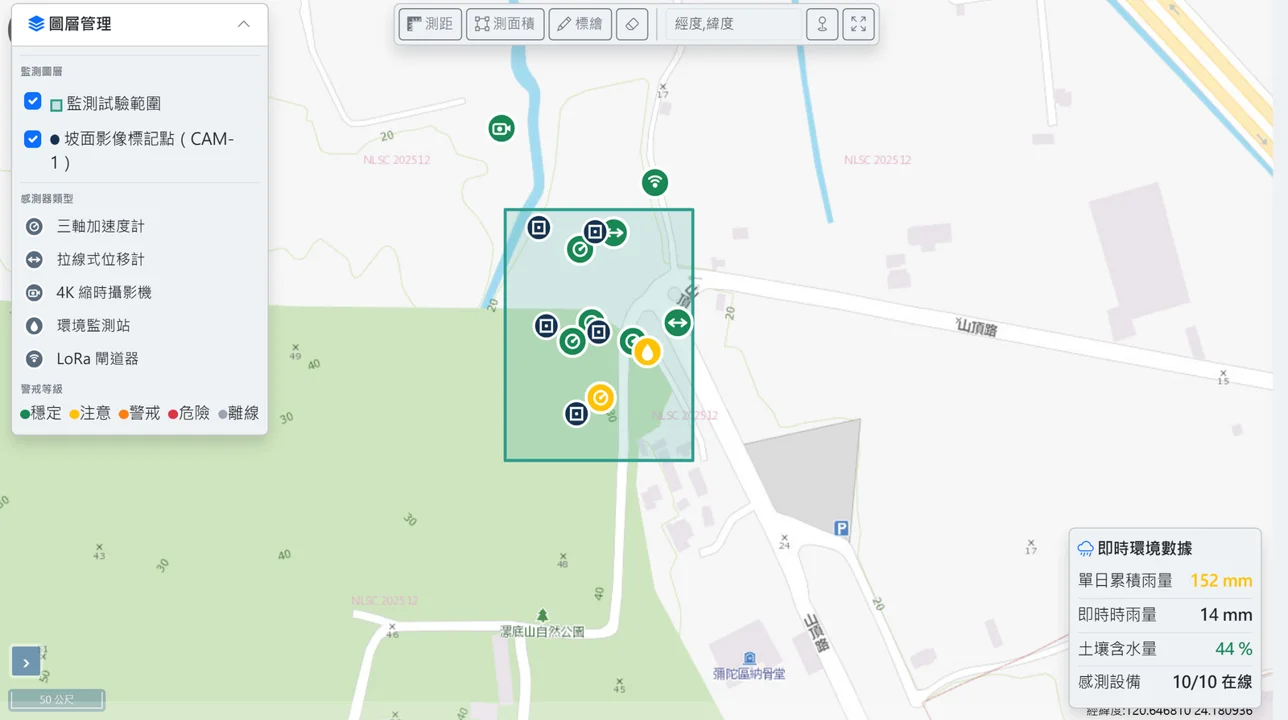
GIS Monitoring Dashboard
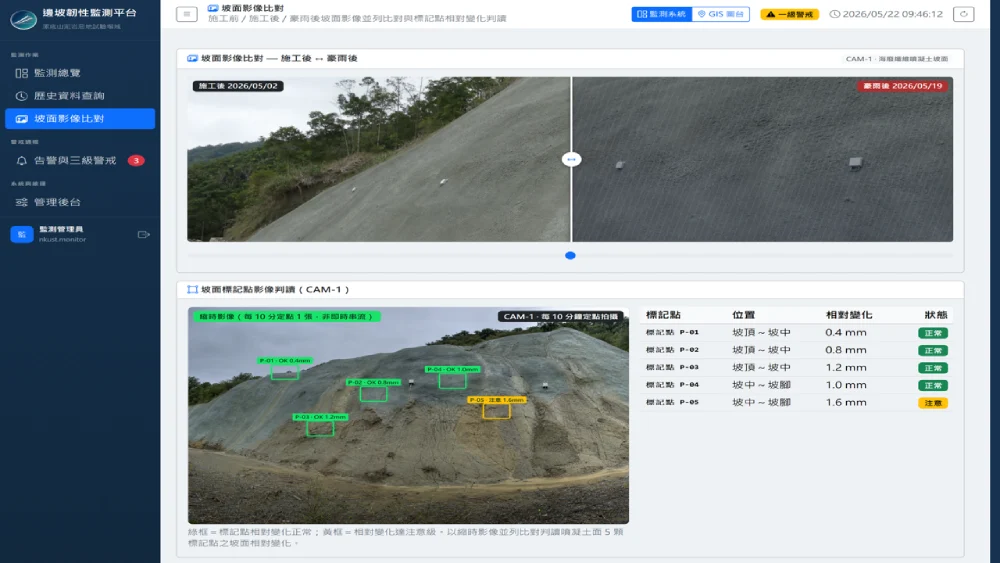
GIS Monitoring Dashboard
The OAC emphasized that, guided by the principle of "taking resources from the sea and using them to protect the sea," the technology successfully integrates the circular economy, AIoT (Artificial Intelligence of Things), and slope disaster prevention. Going forward, the council will continue to promote technology validation and local applications in coastal areas while strengthening cross-sector collaboration among government, industry, academia, and research institutions.
The OAC will also work to expand the research outcomes to geologically vulnerable coastal areas throughout Taiwan, enhancing the nation's marine resilience and industrial competitiveness. Through these efforts, marine waste can be transformed from an environmental burden into a valuable resource for protecting both land and sea, contributing to a safer, more sustainable, and mutually prosperous maritime nation.
Source: The Ocean Affairs Council (OAC)
Compilation & Ttranslation: EnergyOMNI
