

"The Catalyst" Mission: From Shipbuilding to Offshore Industry — Taiwan's Maritime Industrial Vision
"The Catalyst" Mission: From Shipbuilding to Offshore Industry — Taiwan's Maritime Industrial Vision
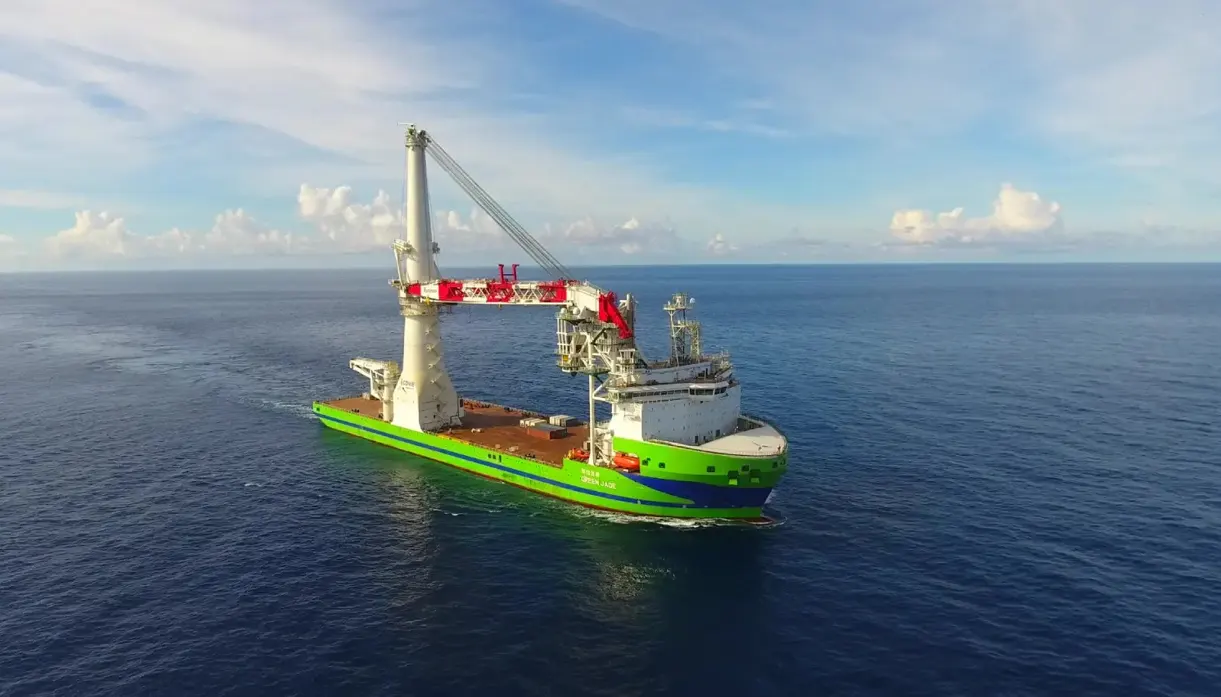 The "Green Jade" is a multifunctional large-scale marine engineering vessel owned by CSBC-DEME Wind Engineering (CDWE) and constructed by CSBC Corporation, Taiwan. It represents the most advanced vessel of its kind in Taiwan — and one of only a few of its class worldwide. Equipped with a DP3 dynamic positioning system, the Green Jade is capable of performing precision operations in deep waters and challenging seabed conditions, unconstrained by depth limitations.
He defines himself as a catalyst. From leading CSBC's first self-designed merchant vessel in the 1990s to driving Taiwan's offshore wind and marine engineering industry today, Robert Tseng has consistently emphasized that his focus is not on personal achievements, but on creating positive industrial cycles. In his view, only when an industry's environment improves can enterprises truly thrive — and to him, "running the company well and lifting the entire industry" is the highest form of purpose.
From Self-Designed Ships to Specialized Vessels: Catalyzing the First Positive Cycle
In the early 1990s, Tseng led his team at CSBC to complete the company's first independently designed merchant vessel — a milestone that transformed Taiwan's shipbuilding industry from contract manufacturing to independent R&D and design. Within a few years, CSBC's operating model was completely restructured: 99% of its merchant ship design, construction, and marketing became fully localized.
CSBC soon expanded from traditional bulk carriers to large container ships, such as Yang Ming Marine's 14,000 TEU vessels, and eventually entered the high-end global market of specialized ships. Among its most notable successes were the semi-submersible heavy-lift vessels Blue Marlin and Black Marlin, originally built by CSBC and later transferred to Boskalis. These ships remain active worldwide — even returning to Taiwan for offshore wind assignments. For Tseng, seeing "ships built in Taiwan" operate on the world stage and serve the energy industry embodies the first expression of his catalytic spirit.
"Shipbuilding is not merely about a product; it represents a nation's capability," he stressed. Although shipbuilding contributes only a small share to Taiwan's GDP, the embedded engineering know-how, supply chain strength, and strategic security value make it an irreplaceable national asset.
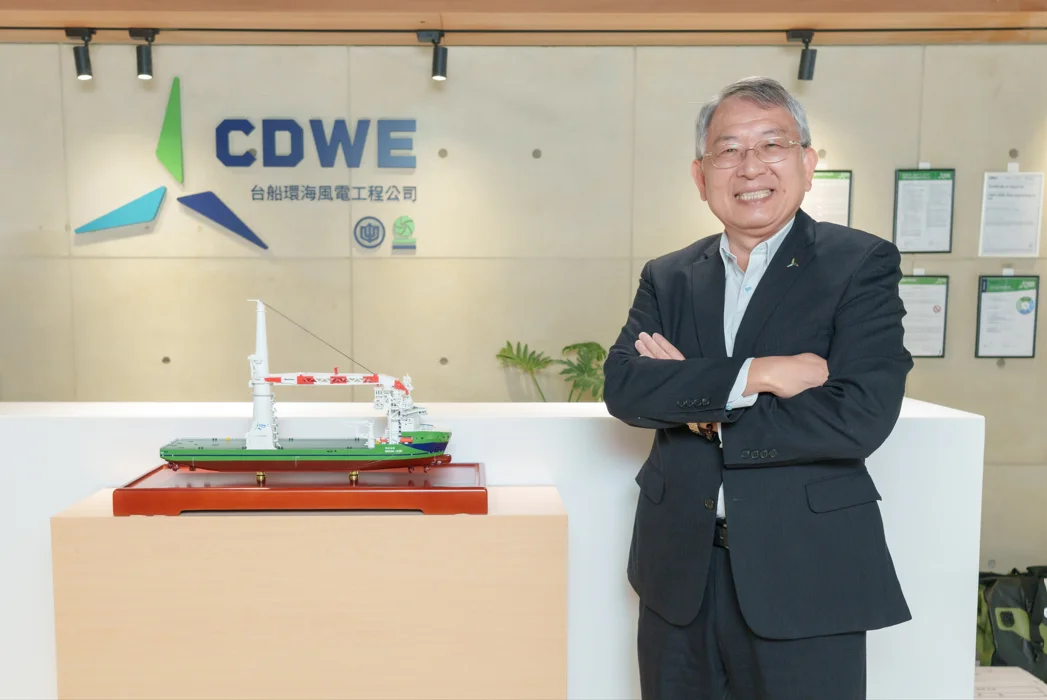 Robert Tseng, Chairman of CSBC-DEME Wind Engineering (CDWE)
The Birth of CDWE and Green Jade: From a Midnight Call to a Cross-Border Partnership
Tseng's catalytic role extended beyond shipbuilding to offshore wind and marine engineering. One night in early 2019, he received a call from an investor at DEME, just landing at Taoyuan Airport, asking whether CSBC could integrate shipbuilding, CDWE's investment, and offshore wind project supply into a single model. That late-night conversation became the seed for the DP3 heavy-lift installation vessel Green Jade.
It took about a year and a half from concept to contract signing, and four and a half years from design to delivery. The hardest part, Tseng recalled, wasn't the shipbuilding itself, but the front-end linkage: aligning with government offshore-wind policies, structuring investments, building shareholder consensus, coordinating port and manufacturing capacity, and ensuring that the supply chain fit EPCI (engineering, procurement, construction, and installation) execution.
During investment reviews, regulators focused heavily on ROI and project pipeline stability. Tseng's team secured priority contracts with key projects such as Hai Long and Chung Neng, convincing investors that long-term revenue sources were assured.
The choice of DEME as shareholder and operations partner was deliberate, he said — the result of rigorous evaluation and over a year of negotiations defining mutual rights and obligations. "Our principle was simple: consensus first, then progress. Disagreements were inevitable, but they were always about issues, never about people," Tseng reflected.
 The Green Jade, owned by CSBC-DEME Wind Engineering (CDWE), is assisting the Hai Long Offshore Wind Project in conducting substructure installation operations.
Steady Governance and Policy Insight: Managing Well Is the Greatest Service to Industry
In 2024, Tseng returned as Chairman of CDWE. His motivation, he said, was straightforward: "Managing the company well is the most powerful thing we can do for the industry."
He acknowledges that the current environment poses major challenges — geopolitical instability, shifting domestic policy, and capital market volatility — yet he believes that as long as CDWE remains solid, Taiwan's entire marine-engineering ecosystem retains its anchor.
From a policy perspective, Tseng repeatedly stresses that shipbuilding and marine engineering should not be evaluated by GDP share alone but by national capability. The "indigenous shipbuilding" initiative (國艦國造) revealed how shipbuilding underpins defense and supply-chain resilience. Offshore wind, meanwhile, marks the first time Taiwan has executed large-scale marine construction at sea, creating a visible benchmark.
To turn that benchmark into a cluster, policy continuity is essential. Tseng advocates for a "steady-rolling" rather than "swinging" policy approach, supplemented by tax instruments such as tonnage tax, investment credits, and marine-specific regulatory frameworks to support long-term investment. Marine and shipbuilding projects, he noted, have cycles of over ten years — too long to judge with short-term metrics. Doing so risks suffocating industrial momentum.
"The maturation of marine and offshore engineering must be measured in years of learning and layers of consistent policy support," he said. Only this way can Taiwan drive business investment, stabilize its professional workforce, and upgrade its supply chain. "Compared to major Asia-Pacific nations, Taiwan already shows ambition and strong execution. The priority now is to optimize institutional design and position marine engineering as a strategic pillar within national energy planning."
For Tseng, marine engineering is not merely an economic topic — it's the foundation of energy resilience and industrial internationalization. The "engineering-as-engineering" principle he upholds means that core engineering capabilities are transferable and accumulative across sectors — the bedrock of Taiwan's credibility in regional and global partnerships. When other countries see Taiwan design heavy-lift vessels, execute full-scale offshore wind installations, and deliver complex marine works with local teams, they recognize not only technical strength but also a strategic bargaining chip for Taiwan in international cooperation.
 For Tseng, marine engineering is not merely an economic topic — it's the foundation of energy resilience and industrial internationalization. The "engineering-as-engineering" principle he upholds means that core engineering capabilities are transferable and accumulative across sectors — the bedrock of Taiwan's credibility in regional and global partnerships.
Talent and Globalization: Laying the Groundwork for the Next Blue-Ocean Technologies
For Tseng, people are the most critical long-term asset. Just as Taiwan's "indigenous shipbuilding" succeeded through two decades of talent cultivation, the future of marine engineering likewise depends on comprehensive talent strategies — from academia–industry alliances and internship programs to competency mapping and international recruitment.
He outlines three focus areas:
● Academic–Industry Integration: Collaborate with universities to systematically train engineers, seafarers, operators, and project managers.
● Local–Global Balance: Initially import international expertise, then gradually raise the share of Taiwanese professionals to build a structure of mutual dialogue and complementarity.
● Career Development: Enhance young professionals' awareness of the marine-engineering industry's potential, vision, and career pathways to boost its attractiveness.
Looking toward 2026–2030 and Taiwan's third-round offshore wind developments, Tseng prioritizes team optimization. He believes Taiwan's marine-engineering teams can increase their local participation from roughly 50% today to 70%, ultimately building a "Taiwan Team" capable of executing full-scope EPCI projects.
At the same time, "demonstration projects must not stop," he insists. Whether it's floating wind, CCUS subsea drilling, or international subsea cable projects, continuous pilot platforms are vital to preserve technical depth and team continuity — preventing knowledge loss between policy phases.
On globalization, he says two conditions must mature: sufficient domestic capability and brand reputation, and shareholder alignment on regional strategy. Once these are met, "Taiwan absolutely can follow the paths of Denmark or Norway — bringing its local supply chain onto the global stage."
"Peers from Southeast and Northeast Asia often envy Taiwan," he added. "Not only do we have our own offshore sites, but also our heavy-lift vessel and local crews. If policies remain consistent and demonstration projects continue, Taiwan can truly become a maritime nation."
Catalyzing and Accumulating: Driving Sustainable Industrial Growth
Over more than three decades, Robert Tseng has witnessed Taiwan's shipbuilding journey — from OEM to self-design, from conventional to specialized vessels, from merchant ships to naval programs. Now, in offshore wind and marine engineering, he hopes once again to embody the spirit of the catalyst.
"When the company stands firm, the industry finds its footing. When the engine runs steady, the supply chain follows. When young talent sees a future, they join. And when that happens, the world sees Taiwan's reliability and efficiency," he said.
His pursuit is not just to complete individual projects, but to transform tangible benchmarks, replicable mechanisms, and sustainable talent pipelines into long-term competitiveness. Through such catalytic accumulation, Taiwan can evolve from doing a few things well to consistently doing the right things well — to build, endure, and expand.
Ultimately, when marine engineering becomes the core driver of Taiwan's energy transition and global influence, that underlying strength — the quiet confidence born of real capability — will stand as the nation's most solid support on the international stage.

More related articles
